COPPER

A PS Audio Publication

Issue 194 • Free Online Magazine

Issue 194 Featured

Dreamin’ Wild: The Movie and the Music

Dreamin’ Wild: The Movie and the Music

Actress Lana Turner was discovered while drinking a milkshake at Schwab’s pharmacy. Pam Anderson was at a football game when her picture suddenly flashed across the Jumbotron. Justin Bieber’s journey to fame began by uploading cover songs to YouTube. But perhaps no road to discovery is more circuitous than that of the Emerson brothers, two 1970’s teen musicians hailing from Fruitland, Washington, a small farming town better known for producing apples and wheat than pop stars.

Donnie and Joe Emerson’s musical journey is well-chronicled in the just released feature film Dreamin’ Wild, titled after the brothers’ 1979 album of the same name. The film is a true story starring Casey Affleck as adult brother Donnie, Zooey Deschanel as his wife Nancy, and Walton Goggins as adult brother Joe. Beau Bridges and Barbara Deering are cast as the boys’ father and mother, respectively.


Casey Affleck and Zooey Deschanel as Donnie and Nancy Emerson.


Dreamin’ Wild is a story about sacrifice, love, and a parent’s belief in the musical aspirations of their children, particularly younger son Donnie, a multi-talented instrumentalist and singer-songwriter. The boys’ father, Don Sr., was so committed to his sons’ musical pursuits that he mortgaged and subsequently lost roughly 1,500 acres of farmland to finance their dreams, including constructing a home recording studio where the Dreamin’ Wild LP was produced.

The Emerson’s farm-based studio had a control room, a then state-of-the-art TEAC eight-track recorder, a Moog synthesizer, and carpeted floor and walls for soundproofing. The family funded and pressed 2,000 vinyl copies of Dreamin’ Wild in 1979, but the album didn’t generate much traction, even among the locals. The album languished in obscurity until a known record collector and music blogger, Jack Fleischer, purchased the album for $5.00 in a Spokane antique shop in 2008.

Shortly thereafter the 30-year-old album started to blow up with music bloggers and in early-stage social media. When the buzz and album’s sound reached the ears of Matt Sullivan, co-owner of Seattle-based Light In The Attic Records (LITA), a reissuing label perhaps best known for rediscovering Sixto Rodriquez of Searching for Sugarman fame, he jumped all over the opportunity.

When Sullivan (portrayed in the film by Chris Messina) subsequently met with the Emersons he discovered they still had most of the original analog tape from their 1979 recording sessions. “They did a very good job of preserving what they had,” Sullivan shared with Copper. “The tapes were kept in a storage locker in a climate-controlled room. They definitely knew what they were doing, and they were very professional about taking care of things.”

LITA reissued Dreamin’ Wild in 2012, and the album’s cult-like buzz just kept growing. The online music pub Pitchfork rated the reissued LP an 8 out of 10, calling it “a godlike symphony to teenhood.” The New York Times then published a lengthy piece on the Emerson brothers’ improbable road to discovery, thereby reaching a far more mainstream audience. 

The songs on Dreamin’ Wild cover a range of musical genres from power pop to soul to funk. The album is a reflection of the era in which it was conceived, and it possesses a far more demo-like quality than the polished (sometimes overproduced) sound of today’s hits. Nonetheless, there’s purity to the brothers’ sound, and it’s easy to appreciate Donnie’s writing chops, even as a young teen. His talent is evident in the album’s song structure and development.

While we’re all familiar with the expression “don’t judge a book by its cover,” the Dreamin’ Wild LP shouldn’t be judged by its cover, either. The cover photo features the brothers in an Elvis Presley high-collar fashion look. As 17 (Donnie) and 19 (Joe) year-old teens, the brothers were hardly marketing savvy, though they certainly could have chosen a far less successful role model to emulate.


Dreamin' Wild, album cover. Courtesy of Light in the Attic Records.


The vocals on the Dreamin’ Wild LP are heavy with reverb, reminiscent of early 1960s British pop, while some tracks have a particularly strong bass mix. The opening track is “Good Time,” a quintessential power pop tune that should be cranked to the despair of one’s neighbor. Arguably, the two best songs on the LP are “Baby,” a sultry, soul-oriented track, and “Dream Full of Dreams,” a warm piano ballad that makes good use of the home studio Moog. “Baby” was also featured in the soundtrack to the film Celeste and Jesse Forever, while indie artist Ariel Pink covered the song on his LP Mature Themes. The closing track on the album is “My Heart,” a tune with strong roots in techno-pop.


Regarding Dreamin’ Wild the film, Copper attended a screening of the movie this past May at the Seattle International Film Festival. More recently, we caught up with the film’s writer, director and producer, Bill Pohlad, to chat about the movie and the music. Pohlad also directed the highly regarded biopic Love and Mercy about the Beach Boys’ Brian Wilson. His other film credits include executive producer or producer on Brokeback Mountain, A Prairie Home Companion, and 12 Years A Slave.

Stuart Marvin: Hi Bill, initially you were on the fence about directing Dreamin’ Wild. What was it about finally meeting Donnie and the Emerson family that changed your mind?

Bill Pohlad: Donnie picked us up at the Spokane airport and drove us to the Fruitland farm, which is a couple of hours away. I got to see the farm and the community. I got to know Donnie – as best one can in a few hours – and I was fascinated by his whole being. When we drove back to Spokane it was the middle of the night, and Donnie was talking about his life. He eventually broke down in tears, and I said to myself, ‘wow, there’s a lot going on here, a lot of emotion, and a lot of things below the surface.’ Eventually I met the parents, got to know brother Joe a little bit better, and I became captivated by them all.

SM: Did the Dreamin’ Wild LP appeal to your musical sensibilities?

BP: Absolutely. The first time I heard “Baby” it felt like the kind of song that you’ve known all your life. It had a dreamy, mystical quality to it. It really appealed to me. It’s definitely the kind of music that I’m generally attracted to.  


SM: Casey Affleck’s interpretation of Donnie seems pretty low key and introspective. Was that an accurate portrayal of Donnie’s persona?

BP: I wanted Casey for that very reason. He has the quality to make Donnie seem “otherworldly.” Sometimes Donnie’s off dreaming and seems disconnected from the world as it is right now, which I’m attracted to in a way. I really thought Casey had the ability to pull that off. He has some of those same qualities naturally, and that’s why I was drawn to him for the role. 

SM: Did you do anything to the Dreamin’ Wild LP’s sound to make it more suitable for the big screen?

BP: Donnie and his band re-recorded a lot of the songs we wanted to use, so it would be appropriate for the various settings we were putting him in, like a bar or different locations. Sometimes we’d use the original (album) track, and sometimes we’d use Noah and Jack’s version (Noah Jupe and Jack Dylan Grazer play younger Donnie and Joe, respectively), which has a sense of youth and immediacy to it, and a far less finished quality. You don’t want them rehearsing and sounding like they had a finished track.
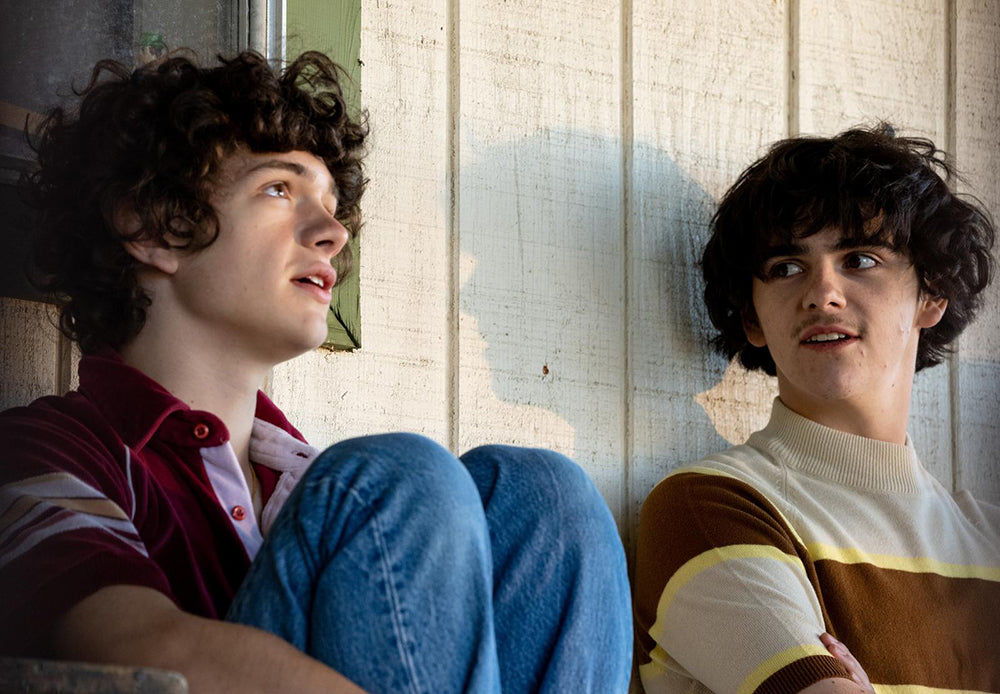
 

Noah Jupe and Jack Dylan Grazer as the younger Donnie and Joe Emerson. Courtesy of River Road Entertainment.


SM: Tell me about the song “When A Dream Is Beautiful” that Donnie wrote for the film. What was the genesis of that, and did you think you needed something fresh and new to bring the story full cycle?

BP: You know, in normal Hollywood fashion you’d think these guys would go through their struggles, have a day of reckoning, and come out the other end as huge stars. That didn’t happen with Donnie and Joe. That’s not how the story plays out, and that’s why I liked it. You do want a strong movie ending, some resolution that helps the audience complete this journey with them. People would ask, where’s Donnie now? Well, he’s still making music, and I wanted some representation of that. So I talked to Donnie about that and we went back and forth. To be honest, the period of film production was not easy for him, as it wouldn’t be for anybody. The idea of having a movie made about one’s self is really daunting. You think [the idea] sounds great, but there’s a lot of emotional stuff going on with him and the family. I think Donnie was naturally afraid of what was happening. We didn’t talk a lot during production, but I always had in my mind that maybe he would write a song for the end of the movie. Once I heard it, I knew that was it.

SM: Thanks for your time, Bill, and best of luck with the film!

As Pohlad noted, it was very hard for Donnie Emerson to come to terms with the public’s sudden out-of-the-blue interest in the Dreamin’ Wild LP. It confused and conflicted him. The bizarre timeline was a little too hard for him to process.  Donnie’s musical repertoire had evolved considerably from his teen years, and he was now writing a broader range of material, covering country, smooth jazz, funk and soul.

And what about the possibility of the Emerson’s recovering any of the large financial investment they made so many years ago?  Well, the good news is the Emerson’s retained all of the music’s publishing rights. “It’s a great scenario,” said LITA’s Sullivan. “They’re (now) making money, and not getting a raw end of the deal, which is so common in the entertainment business.”

Sullivan then summed up LITA’s relationship with the family this way: “in our 22-year history, with over 250 releases, the Emerson’s are at the top of the list of wonderful people to work with, regardless of the album’s success or not. They’re just lovely people.”

Let’s hear it for the good guys.


The Dreamin’ Wild: Original Motion Picture Soundtrack and the original Dreamin’ Wild’ LP (1979) are available on Light In The Attic Records. 

Dreamin’ Wild, the movie, is in theaters everywhere.

Header image: Casey Affleck as Donnie Emerson. Courtesy of River Road Entertainment.


More from Issue 194

View All Articles in Issue 194

Search Copper Magazine

#230 Camaraderie by B. Jan Montana May 04, 2026 #230 AXPONA 2026: A Family Gathering by Paul McGowan May 04, 2026 #230 Pianist Ryan Benthall Explores Jazz Realms and Far Beyond With Divine Sky by Frank Doris May 04, 2026 #230 The Vinyl Beat in AXPONA-Land by Rudy Radelic May 04, 2026 #230 Teddy Thompson’s Musical Growth Deepens With Never Be the Same by Ray Chelstowski May 04, 2026 #230 More Fun in the Sun: Florida Audio Expo, Part Two by Frank Doris May 04, 2026 #230 CanJam NYC 2026 Show Report: Heady Sound, Part Two by Frank Doris and Harris Fogel May 04, 2026 #230 Sonic Youth On Murray Street by Wayne Robins May 04, 2026 #230 Graffeo Coffee: A Symphony of Sensory Experience by Joe Caplan May 04, 2026 #230 The Saul Authority: The Story of Hi-Fi Pioneer Saul Marantz by Olivier Meunier-Plante May 04, 2026 #230 How to Play in a Rock Band, 23: Encounters With Famous Musicians, Part Two by Frank Doris May 04, 2026 #230 An Outlier in the Rack: A Vintage BIC Beam Box by The Staff at Just Audio May 04, 2026 #230 PS Audio in the News by PS Audio Staff May 04, 2026 #230 A Cautionary Tale by Rich Isaacs May 04, 2026 #230 Reel-to-Reel Roots, Part 33 (Revised): Ken Kessler Reports On the 2026 (British) AudioJumble by Ken Kessler May 04, 2026 #230 Text Messaging by Frank Doris May 04, 2026 #230 The Audiophile Rat Race by Peter Xeni May 04, 2026 #230 On the Rocks by Rich Isaacs May 04, 2026 #229 The Earliest Stars of Country Music, Part Three by Jeff Weiner Apr 06, 2026 #229 The Healing Power of Music and Sound at the Omega Institute by Joe Caplan Apr 06, 2026 #229 CanJam NYC 2026 Show Report: Heady Sound, Part One by Frank Doris Apr 06, 2026 #229 Florida Audio Expo 2026: Warming Up to High-End Audio, Part One by Frank Doris Apr 06, 2026 #229 Quick Takes: Anne Bisson, Sam Morrison, The Velvet Underground, and the Stooges by Frank Doris Apr 06, 2026 #229 The Vinyl Beat: New Arrivals, and Old Audio Show Demo Scores to Settle by Rudy Radelic Apr 06, 2026 #229 Harvard Gets a High-End Audio Education by Frank Doris Apr 06, 2026 #229 No Country for Old Knees by B. Jan Montana Apr 06, 2026 #229 How To Play in A Rock Band, 22: Encounters With Famous Musicians, Part 1 by Frank Doris Apr 06, 2026 #229 The Soulful Grooves of Guinea-Bissau by Steve Kindig Apr 06, 2026 #229 Four-Hand Piano Performance at Its Finest by Stephan Haberthür Apr 06, 2026 #229 The People Who Make Audio Happen: Supreme Acoustics Systems’ Las Vegas Grand Opening by Harris Fogel Apr 06, 2026 #229 Blue Öyster Cult: Tyranny and Expectations by Wayne Robins Apr 06, 2026 #229 Guitarist Rick Vito’s Cinematic New Album, Slidemaster by Ray Chelstowski Apr 06, 2026 #229 Measurements and Observational Listening by Paul McGowan Apr 06, 2026 #229 PS Audio in the News by PS Audio Staff Apr 06, 2026 #229 Back to My Reel-to-Reel Roots, Part 28: The Cassette Strikes Back by Ken Kessler Apr 06, 2026 #229 Are You Receiving Me? by Frank Doris Apr 06, 2026 #229 Hospitality by Peter Xeni Apr 06, 2026 #229 Cantina Gateway by James Schrimpf Apr 06, 2026 #228 Serita’s Black Rose Duo Shakes Your Soul With a Blend of Funk, Rock, Blues and a Whole Lot More by Frank Doris Mar 02, 2026 #228 Vinyl, A Love Story by Wayne Robins Mar 02, 2026 #228 Thrill Seeker by B. Jan Montana Mar 02, 2026 #228 The Vinyl Beat: Donald Byrd, Bill Evans, Wes Montgomery, Eddie Palmieri and Frank Sinatra by Rudy Radelic Mar 02, 2026 #228 Listening to Prestige: The History of a Vitally Important Jazz Record Label by Frank Doris Mar 02, 2026 #228 How to Play in a Rock Band, 21: Touring With James Lee Stanley by Frank Doris Mar 02, 2026 #228 The NAMM 2026 Show: The Music Industry’s Premier Event by John Volanski Mar 02, 2026 #228 The Earliest Stars of Country Music, Part Two by Jeff Weiner Mar 02, 2026 #228 From The Audiophile's Guide: A Brief History of Stereophonic Sound by Paul McGowan Mar 02, 2026

Dreamin’ Wild: The Movie and the Music

<em>Dreamin’ Wild:</em> The Movie and the Music

Actress Lana Turner was discovered while drinking a milkshake at Schwab’s pharmacy. Pam Anderson was at a football game when her picture suddenly flashed across the Jumbotron. Justin Bieber’s journey to fame began by uploading cover songs to YouTube. But perhaps no road to discovery is more circuitous than that of the Emerson brothers, two 1970’s teen musicians hailing from Fruitland, Washington, a small farming town better known for producing apples and wheat than pop stars.

Donnie and Joe Emerson’s musical journey is well-chronicled in the just released feature film Dreamin’ Wild, titled after the brothers’ 1979 album of the same name. The film is a true story starring Casey Affleck as adult brother Donnie, Zooey Deschanel as his wife Nancy, and Walton Goggins as adult brother Joe. Beau Bridges and Barbara Deering are cast as the boys’ father and mother, respectively.


Casey Affleck and Zooey Deschanel as Donnie and Nancy Emerson.


Dreamin’ Wild is a story about sacrifice, love, and a parent’s belief in the musical aspirations of their children, particularly younger son Donnie, a multi-talented instrumentalist and singer-songwriter. The boys’ father, Don Sr., was so committed to his sons’ musical pursuits that he mortgaged and subsequently lost roughly 1,500 acres of farmland to finance their dreams, including constructing a home recording studio where the Dreamin’ Wild LP was produced.

The Emerson’s farm-based studio had a control room, a then state-of-the-art TEAC eight-track recorder, a Moog synthesizer, and carpeted floor and walls for soundproofing. The family funded and pressed 2,000 vinyl copies of Dreamin’ Wild in 1979, but the album didn’t generate much traction, even among the locals. The album languished in obscurity until a known record collector and music blogger, Jack Fleischer, purchased the album for $5.00 in a Spokane antique shop in 2008.

Shortly thereafter the 30-year-old album started to blow up with music bloggers and in early-stage social media. When the buzz and album’s sound reached the ears of Matt Sullivan, co-owner of Seattle-based Light In The Attic Records (LITA), a reissuing label perhaps best known for rediscovering Sixto Rodriquez of Searching for Sugarman fame, he jumped all over the opportunity.

When Sullivan (portrayed in the film by Chris Messina) subsequently met with the Emersons he discovered they still had most of the original analog tape from their 1979 recording sessions. “They did a very good job of preserving what they had,” Sullivan shared with Copper. “The tapes were kept in a storage locker in a climate-controlled room. They definitely knew what they were doing, and they were very professional about taking care of things.”

LITA reissued Dreamin’ Wild in 2012, and the album’s cult-like buzz just kept growing. The online music pub Pitchfork rated the reissued LP an 8 out of 10, calling it “a godlike symphony to teenhood.” The New York Times then published a lengthy piece on the Emerson brothers’ improbable road to discovery, thereby reaching a far more mainstream audience. 

The songs on Dreamin’ Wild cover a range of musical genres from power pop to soul to funk. The album is a reflection of the era in which it was conceived, and it possesses a far more demo-like quality than the polished (sometimes overproduced) sound of today’s hits. Nonetheless, there’s purity to the brothers’ sound, and it’s easy to appreciate Donnie’s writing chops, even as a young teen. His talent is evident in the album’s song structure and development.

While we’re all familiar with the expression “don’t judge a book by its cover,” the Dreamin’ Wild LP shouldn’t be judged by its cover, either. The cover photo features the brothers in an Elvis Presley high-collar fashion look. As 17 (Donnie) and 19 (Joe) year-old teens, the brothers were hardly marketing savvy, though they certainly could have chosen a far less successful role model to emulate.


Dreamin' Wild, album cover. Courtesy of Light in the Attic Records.


The vocals on the Dreamin’ Wild LP are heavy with reverb, reminiscent of early 1960s British pop, while some tracks have a particularly strong bass mix. The opening track is “Good Time,” a quintessential power pop tune that should be cranked to the despair of one’s neighbor. Arguably, the two best songs on the LP are “Baby,” a sultry, soul-oriented track, and “Dream Full of Dreams,” a warm piano ballad that makes good use of the home studio Moog. “Baby” was also featured in the soundtrack to the film Celeste and Jesse Forever, while indie artist Ariel Pink covered the song on his LP Mature Themes. The closing track on the album is “My Heart,” a tune with strong roots in techno-pop.


Regarding Dreamin’ Wild the film, Copper attended a screening of the movie this past May at the Seattle International Film Festival. More recently, we caught up with the film’s writer, director and producer, Bill Pohlad, to chat about the movie and the music. Pohlad also directed the highly regarded biopic Love and Mercy about the Beach Boys’ Brian Wilson. His other film credits include executive producer or producer on Brokeback Mountain, A Prairie Home Companion, and 12 Years A Slave.

Stuart Marvin: Hi Bill, initially you were on the fence about directing Dreamin’ Wild. What was it about finally meeting Donnie and the Emerson family that changed your mind?

Bill Pohlad: Donnie picked us up at the Spokane airport and drove us to the Fruitland farm, which is a couple of hours away. I got to see the farm and the community. I got to know Donnie – as best one can in a few hours – and I was fascinated by his whole being. When we drove back to Spokane it was the middle of the night, and Donnie was talking about his life. He eventually broke down in tears, and I said to myself, ‘wow, there’s a lot going on here, a lot of emotion, and a lot of things below the surface.’ Eventually I met the parents, got to know brother Joe a little bit better, and I became captivated by them all.

SM: Did the Dreamin’ Wild LP appeal to your musical sensibilities?

BP: Absolutely. The first time I heard “Baby” it felt like the kind of song that you’ve known all your life. It had a dreamy, mystical quality to it. It really appealed to me. It’s definitely the kind of music that I’m generally attracted to.  


SM: Casey Affleck’s interpretation of Donnie seems pretty low key and introspective. Was that an accurate portrayal of Donnie’s persona?

BP: I wanted Casey for that very reason. He has the quality to make Donnie seem “otherworldly.” Sometimes Donnie’s off dreaming and seems disconnected from the world as it is right now, which I’m attracted to in a way. I really thought Casey had the ability to pull that off. He has some of those same qualities naturally, and that’s why I was drawn to him for the role. 

SM: Did you do anything to the Dreamin’ Wild LP’s sound to make it more suitable for the big screen?

BP: Donnie and his band re-recorded a lot of the songs we wanted to use, so it would be appropriate for the various settings we were putting him in, like a bar or different locations. Sometimes we’d use the original (album) track, and sometimes we’d use Noah and Jack’s version (Noah Jupe and Jack Dylan Grazer play younger Donnie and Joe, respectively), which has a sense of youth and immediacy to it, and a far less finished quality. You don’t want them rehearsing and sounding like they had a finished track.


Noah Jupe and Jack Dylan Grazer as the younger Donnie and Joe Emerson. Courtesy of River Road Entertainment.


SM: Tell me about the song “When A Dream Is Beautiful” that Donnie wrote for the film. What was the genesis of that, and did you think you needed something fresh and new to bring the story full cycle?

BP: You know, in normal Hollywood fashion you’d think these guys would go through their struggles, have a day of reckoning, and come out the other end as huge stars. That didn’t happen with Donnie and Joe. That’s not how the story plays out, and that’s why I liked it. You do want a strong movie ending, some resolution that helps the audience complete this journey with them. People would ask, where’s Donnie now? Well, he’s still making music, and I wanted some representation of that. So I talked to Donnie about that and we went back and forth. To be honest, the period of film production was not easy for him, as it wouldn’t be for anybody. The idea of having a movie made about one’s self is really daunting. You think [the idea] sounds great, but there’s a lot of emotional stuff going on with him and the family. I think Donnie was naturally afraid of what was happening. We didn’t talk a lot during production, but I always had in my mind that maybe he would write a song for the end of the movie. Once I heard it, I knew that was it.

SM: Thanks for your time, Bill, and best of luck with the film!

As Pohlad noted, it was very hard for Donnie Emerson to come to terms with the public’s sudden out-of-the-blue interest in the Dreamin’ Wild LP. It confused and conflicted him. The bizarre timeline was a little too hard for him to process.  Donnie’s musical repertoire had evolved considerably from his teen years, and he was now writing a broader range of material, covering country, smooth jazz, funk and soul.

And what about the possibility of the Emerson’s recovering any of the large financial investment they made so many years ago?  Well, the good news is the Emerson’s retained all of the music’s publishing rights. “It’s a great scenario,” said LITA’s Sullivan. “They’re (now) making money, and not getting a raw end of the deal, which is so common in the entertainment business.”

Sullivan then summed up LITA’s relationship with the family this way: “in our 22-year history, with over 250 releases, the Emerson’s are at the top of the list of wonderful people to work with, regardless of the album’s success or not. They’re just lovely people.”

Let’s hear it for the good guys.


The Dreamin’ Wild: Original Motion Picture Soundtrack and the original Dreamin’ Wild’ LP (1979) are available on Light In The Attic Records. 

Dreamin’ Wild, the movie, is in theaters everywhere.

Header image: Casey Affleck as Donnie Emerson. Courtesy of River Road Entertainment.


0 comments

Leave a comment

0 Comments

Your avatar

Loading comments...

🗑️ Delete Comment

Enter moderator password to delete this comment:

✏️ Edit Comment

Enter your email to verify ownership: