COPPER

A PS Audio Publication

Issue 96 • Free Online Magazine

Issue 96 VINTAGE WHINE

Drive, He Said Part 5

In Part 4 of this series, the last turntable mentioned was the unusual Mag-Lev levitating turntable. It was first offered as a Kickstarter crowdfunding campaign, and has now joined the Crowdfunding Hall of Infamy as yet another campaign that has failed to deliver products to its backers. Oops. Anyone remember the solar-powered cooler that raised $12M on Kickstarter and then told backers, “gee, we can’t produce these at the price we promised. If you’ll send us $xxx more, we’ll see what we can do”?

Anyway. Scratch Mag-Lev.

In this wrap-up, the last Vintage Whine, we’ll look at just a few unusual turntables: some that I thought showed great promise, and one that is well…. Let’s see if you can sort out which is which.

Back in the ’80s, I owned a Nakamichi Dragon Cassette Deck—and the Nakamichi Dragon turntable, which is not as well known. I’ll cut short the “I wish I’d never sold it ” story—you can find plenty of that on Audiogon, if you’re so inclined.

Anyway: both were brilliant products, beautifully-made. I think the table was made by Mitsubishi, but I may be wrong. The interesting thing about the Dragon turntable was that it wasn’t, in fact, the top of the line; that had been the Nakamichi TX-1000, which sold for about $8,000 in the mid-’80s—- a LOT for the time, and about $20,000 today. The principle behind the TX-1000’s existence was brilliantly-simple, and yet astonishing in its boldness: the center holes of many records are not perfectly centered: they are offset from center, ever so slightly. The result is a persistent, low-level wow that we are so used to hearing that we don’t notice it until it’s gone. What the Nakamichi tables did was correct for that out-of-roundness, and eliminate that wow.

The ever-contrarian Robert E. Greene of The Absolute Sound wrote at length about what happens when that wow is removed; long story short, greater clarity, realism, yadda yadda. Veils drop, I heard my records for the first time. You know the drill. The normally conservative Roger S. Gordon at Positive Feedback also wrote about the TX-1000. Let’s just say he liked it, a lot.
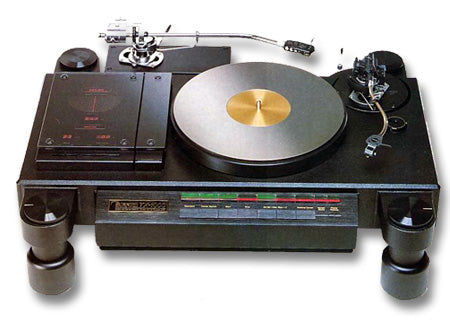
The Nak TX-1000. Anyone else see the later VPI TNT in this?

So: during what appeared to be the last gasp of vinyl records as CDs were becoming dominant, here was a technology that offered the clarity of CDs out of plain old licorice pizzas. How? Well, read REG’s description. But basically, a second arm traced the spinning record before playing commenced, sensed the level of eccentricity, and shifted the main platter atop a sub-platter to ensure that the resultant playback would be without eccentricity—without wow.

It was brilliant, and it worked. The TX-1000 was the first, the ultimate; the Dragon turntable like I had was the simplified, less-expensive version—and the level of clarity and dynamics was still startling. At $2000 in 1985, there was no way I could’ve afforded it, had I not bought it used from a sailor who’d bought it at a PX in Japan.

Nakamichi Dragon CT

The Dragon table: simple, not as complex or pretty, 1/4th the price of the TX-1000.

For me, one of the tragedies of the ascendancy of CDs was that Nakamichi lost its way and ultimately became another formerly-great name attached to pointless, cheaply-made audio tchotchkes. Meh.

At any rate, the two Nak tables were brilliant products, badly-timed. The collector’s market has acknowledged their worth, and TX-1000s are now often upwards of $20,000.

So: we’ve beaten to death the different drive-mechanisms of various turntables. One of the factors often mentioned is the ability of various drives to damp resonances—so how better to do that than by literally being damp?

…as in, turn the platter with …WATER!?!

That was the approach taken by the Oasis turntable, back in the late ’70s. The Oasis was supposedly named Product of the Year at the 1979 CES—I can’t verify that—which points out how much CES has changed over the last 40 years. I believe it was announced that it would be distributed by Polk Audio, but apparently very few were ever built, following a shop fire which destroyed the stock of parts.

There is a watertight circular tank made of clear acrylic. Contained within the tank is an impeller, also made of acrylic—and although I’ve never seen it detailed, I would guess the impeller was belt driven. An acrylic platter with vanes mounted on the bottom was placed within the tank, and when the impeller turned…so did the platter.

Information on the Oasis is fragmentary; but a good bit of info is contained in this article on a restoration project. I have a lot of questions regarding the level of precision required in the fit of the various elements, how long it took to reach speed, and on and on…

Related image

Audio dealer Gig Harbor Audio produced a video featuring the table above, and announced that designer Dave Gillespie would be making new Oasis tables. So far that hasn’t happened, but it’s nice to know that creative minds are still at work.

I’ll miss exploring audio history in Vintage Whine—and I’d like to encourage readers to continue their own journeys of exploration.

More from Issue 96

View All Articles in Issue 96

Search Copper Magazine

#226 JJ Murphy’s Sleep Paralysis is a Genre-Bending Musical Journey Through Jazz, Fusion and More by Frank Doris Jan 05, 2026 #226 Stewardship by Consent by B. Jan Montana Jan 05, 2026 #226 Food, Music, and Sensory Experience: An Interview With Professor Jonathan Zearfoss of the Culinary Institute of America by Joe Caplan Jan 05, 2026 #226 Studio Confidential: A Who’s Who of Recording Engineers Tell Their Stories by Frank Doris Jan 05, 2026 #226 Pilot Radio is Reborn, 50 Years Later: Talking With CEO Barak Epstein by Frank Doris Jan 05, 2026 #226 The Vinyl Beat Goes Down to Tijuana (By Way of Los Angeles), Part One by Rudy Radelic Jan 05, 2026 #226 Capital Audiofest 2025: Must-See Stereo, Part Two by Frank Doris Jan 05, 2026 #226 My Morning Jacket’s Carl Broemel and Tyler Ramsey Collaborate on Their Acoustic Guitar Album, Celestun by Ray Chelstowski Jan 05, 2026 #226 The People Who Make Audio Happen: CanJam SoCal 2025, Part Two by Harris Fogel Jan 05, 2026 #226 How to Play in a Rock Band, 19: Touring Can Make You Crazy, Part One by Frank Doris Jan 05, 2026 #226 Linda Ronstadt Goes Bigger by Wayne Robins Jan 05, 2026 #226 From The Audiophile’s Guide: Active Room Correction and Digital Signal Processing by Paul McGowan Jan 05, 2026 #226 PS Audio in the News by Frank Doris Jan 05, 2026 #226 Back to My Reel-to-Reel Roots, Part 25: Half-Full, Not Empty by Ken Kessler Jan 05, 2026 #226 Happy New Year! by Frank Doris Jan 05, 2026 #226 Turn It Down! by Peter Xeni Jan 05, 2026 #226 Ghost Riders by James Schrimpf Jan 05, 2026 #226 A Factory Tour of Audio Manufacturer German Physiks by Markus "Marsu" Manthey Jan 04, 2026 #225 Capital Audiofest 2025: Must-See Stereo, Part One by Frank Doris Dec 01, 2025 #225 Otis Taylor and the Electrics Delivers a Powerful Set of Hypnotic Modern Blues by Frank Doris Dec 01, 2025 #225 A Christmas Miracle by B. Jan Montana Dec 01, 2025 #225 T.H.E. Show New York 2025, Part Two: Plenty to See, Hear, and Enjoy by Frank Doris Dec 01, 2025 #225 Underappreciated Artists, Part One: Martin Briley by Rich Isaacs Dec 01, 2025 #225 Rock and Roll is Here to Stay by Wayne Robins Dec 01, 2025 #225 A Lifetime of Holiday Record (and CD) Listening by Rudy Radelic Dec 01, 2025 #225 Little Feat: Not Saying Goodbye, Not Yet by Ray Chelstowski Dec 01, 2025 #225 How to Play in a Rock Band, Part 18: Dealing With Burnout by Frank Doris Dec 01, 2025 #225 The People Who Make Audio Happen: CanJam SoCal 2025 by Harris Fogel Dec 01, 2025 #225 Chicago’s Sonic Sanctuaries: Four Hi‑Fi Listening Bars Channeling the Jazz‑Kissa Spirit by Olivier Meunier-Plante Dec 01, 2025 #225 From The Audiophile’s Guide: Controlling Bass Frequencies Through Membrane Absorbers (and How to Build Your Own) by Paul McGowan Dec 01, 2025 #225 Your Editor’s Tips for Attending Audio Shows by Frank Doris Dec 01, 2025 #225 PS Audio in the News by Frank Doris Dec 01, 2025 #225 Back to My Reel-to-Reel Roots, Part 24 by Ken Kessler Dec 01, 2025 #225 Holiday Music by Frank Doris Dec 01, 2025 #225 Puppy Prognostication by Peter Xeni Dec 01, 2025 #225 How to Post Comments on Copper by Frank Doris Dec 01, 2025 #225 Living Color by Rudy Radelic Dec 01, 2025 #224 T.H.E. Show New York 2025, Part One: A New Beginning by Frank Doris Nov 03, 2025 #224 Fool’s Leap of Faith is the Extraordinary Octave Records Debut from Singer/Songwriter Tyler Burba and Visit by Frank Doris Nov 03, 2025 #224 The Beatles’ “Aeolian Cadences.” What? by Wayne Robins Nov 03, 2025 #224 Persona Non Grata by B. Jan Montana Nov 03, 2025 #224 Talking With Recording Engineer Barry Diament of Soundkeeper Recordings, Part Two by Frank Doris Nov 03, 2025 #224 B Sides, B Movies, and Beware of Zombies by Rudy Radelic Nov 03, 2025 #224 The Burn-In Chronicles: 1,000 Hours to Sonic Salvation by Olivier Meunier-Plante Nov 03, 2025 #224 A Conversation With Mat Weisfeld of VPI Industries by Joe Caplan Nov 03, 2025 #224 Blues-Rocker Kenny Wayne Shepherd Celebrates 30 Years of Ledbetter Heights by Ray Chelstowski Nov 03, 2025 #224 Playing in a Rock Band, 17: When Good Gigs Go Bad, Part Two by Frank Doris Nov 03, 2025

Drive, He Said Part 5

In Part 4 of this series, the last turntable mentioned was the unusual Mag-Lev levitating turntable. It was first offered as a Kickstarter crowdfunding campaign, and has now joined the Crowdfunding Hall of Infamy as yet another campaign that has failed to deliver products to its backers. Oops. Anyone remember the solar-powered cooler that raised $12M on Kickstarter and then told backers, “gee, we can’t produce these at the price we promised. If you’ll send us $xxx more, we’ll see what we can do”?

Anyway. Scratch Mag-Lev.

In this wrap-up, the last Vintage Whine, we’ll look at just a few unusual turntables: some that I thought showed great promise, and one that is well…. Let’s see if you can sort out which is which.

Back in the ’80s, I owned a Nakamichi Dragon Cassette Deck—and the Nakamichi Dragon turntable, which is not as well known. I’ll cut short the “I wish I’d never sold it ” story—you can find plenty of that on Audiogon, if you’re so inclined.

Anyway: both were brilliant products, beautifully-made. I think the table was made by Mitsubishi, but I may be wrong. The interesting thing about the Dragon turntable was that it wasn’t, in fact, the top of the line; that had been the Nakamichi TX-1000, which sold for about $8,000 in the mid-’80s—- a LOT for the time, and about $20,000 today. The principle behind the TX-1000’s existence was brilliantly-simple, and yet astonishing in its boldness: the center holes of many records are not perfectly centered: they are offset from center, ever so slightly. The result is a persistent, low-level wow that we are so used to hearing that we don’t notice it until it’s gone. What the Nakamichi tables did was correct for that out-of-roundness, and eliminate that wow.

The ever-contrarian Robert E. Greene of The Absolute Sound wrote at length about what happens when that wow is removed; long story short, greater clarity, realism, yadda yadda. Veils drop, I heard my records for the first time. You know the drill. The normally conservative Roger S. Gordon at Positive Feedback also wrote about the TX-1000. Let’s just say he liked it, a lot.

The Nak TX-1000. Anyone else see the later VPI TNT in this?

So: during what appeared to be the last gasp of vinyl records as CDs were becoming dominant, here was a technology that offered the clarity of CDs out of plain old licorice pizzas. How? Well, read REG’s description. But basically, a second arm traced the spinning record before playing commenced, sensed the level of eccentricity, and shifted the main platter atop a sub-platter to ensure that the resultant playback would be without eccentricity—without wow.

It was brilliant, and it worked. The TX-1000 was the first, the ultimate; the Dragon turntable like I had was the simplified, less-expensive version—and the level of clarity and dynamics was still startling. At $2000 in 1985, there was no way I could’ve afforded it, had I not bought it used from a sailor who’d bought it at a PX in Japan.

Nakamichi Dragon CT

The Dragon table: simple, not as complex or pretty, 1/4th the price of the TX-1000.

For me, one of the tragedies of the ascendancy of CDs was that Nakamichi lost its way and ultimately became another formerly-great name attached to pointless, cheaply-made audio tchotchkes. Meh.

At any rate, the two Nak tables were brilliant products, badly-timed. The collector’s market has acknowledged their worth, and TX-1000s are now often upwards of $20,000.

So: we’ve beaten to death the different drive-mechanisms of various turntables. One of the factors often mentioned is the ability of various drives to damp resonances—so how better to do that than by literally being damp?

…as in, turn the platter with …WATER!?!

That was the approach taken by the Oasis turntable, back in the late ’70s. The Oasis was supposedly named Product of the Year at the 1979 CES—I can’t verify that—which points out how much CES has changed over the last 40 years. I believe it was announced that it would be distributed by Polk Audio, but apparently very few were ever built, following a shop fire which destroyed the stock of parts.

There is a watertight circular tank made of clear acrylic. Contained within the tank is an impeller, also made of acrylic—and although I’ve never seen it detailed, I would guess the impeller was belt driven. An acrylic platter with vanes mounted on the bottom was placed within the tank, and when the impeller turned…so did the platter.

Information on the Oasis is fragmentary; but a good bit of info is contained in this article on a restoration project. I have a lot of questions regarding the level of precision required in the fit of the various elements, how long it took to reach speed, and on and on…

Related image

Audio dealer Gig Harbor Audio produced a video featuring the table above, and announced that designer Dave Gillespie would be making new Oasis tables. So far that hasn’t happened, but it’s nice to know that creative minds are still at work.

I’ll miss exploring audio history in Vintage Whine—and I’d like to encourage readers to continue their own journeys of exploration.

0 comments

Leave a comment

0 Comments

Your avatar

Loading comments...

🗑️ Delete Comment

Enter moderator password to delete this comment: