Copper Magazine · Issue 175 · A free PS Audio publication
Issue 175 Deep Dive

Considering CD’s 40th Birthday

Considering CD’s 40th Birthday

I did not want the Compact Disc’s 40th anniversary to slip by without making a few observations. After all, I covered the format during its peak for Replication News, the CD’s primary trade magazine at the time, at the time, when I was hired in late 1997, and for Medialine until that publication’s demise in 2006.

Acknowledging my love-hate relationship with the CD, I still regularly buy them since they’re so cheap and easy to come by in thrift stores and online sources these days.

In the spring of 1986, when it was considered a state-of-the-art technology, I remember showing off the silver little disc to my students in the popular music course I was co-teaching. The undergraduates didn’t seem much interested, even though they were only about six years younger than me. They were still getting used to MTV, which was the subject of my Master’s project at the time. In one of my bolder classroom moments, I predicted that in a few years’ time they all would be listening to and buying CDs.

Of course, I was not wrong.

Sony introduced the CD first in Japan in February 1982, the beginning of a worldwide revolution that reinvented the record industry, which had been lobbied for several years to go along with the new technology. In fact, the CD’s roots can be said to harken back to 1937 when the idea of pulse code modulation (PCM) was conceived of as a means of audio reproduction. Error detection and correction research emerged in 1950. Then the laser came out of a lab in 1960. In 1967, broadcaster NHK presented a 12-bit digital audio recorder using a 30 kHz sampling rate.

 

The familiar Compact Disc logo. Courtesy of Wikimedia Commons/Sony and Philips/public domain.

The familiar Compact Disc logo. Courtesy of Wikimedia Commons/Sony and Philips/public domain.


Two years later, Dutch physicist Klaas Compaan shared his concept for the CD. In 1970, Philips Research created a glass-master prototype that initially was designed for its 12-inch Video Long Play laser player, demonstrated to the press in 1972. Philips’ scientists realized that the laser could also read audio signals, and they stepped up their efforts to shrink down the disc size for a consumer product that could store an hour of music.

Meanwhile, around the same time in the US, MCA purchased patents and ended up collaborating with Philips on what eventually became the LaserDisc, which launched in the US in 1978.

The talk at the 1977 Tokyo Audio Show was the digital audio disc prototypes presented by Sony, Hitachi, and Mitsubishi, while 35 manufacturers came to the Digital Audio Convention in Tokyo the next year when Philips proposed that the disc be made out of polycarbonate. In 1979, the first CD player prototypes circulated in Europe and Japan. Later that year, Philips and Sony agreed on a sampling rate of 44.1kHz and 16-bit audio.

One of the reasons the CD succeeded – as did DVD-Video for that matter – was that Sony and Philips, partners in the format’s R&D, checked their egos at the door. They took the best elements of their research to make a better product and create the “Red Book” CD audio standard in 1981. It was a rare moment in the entertainment industry.
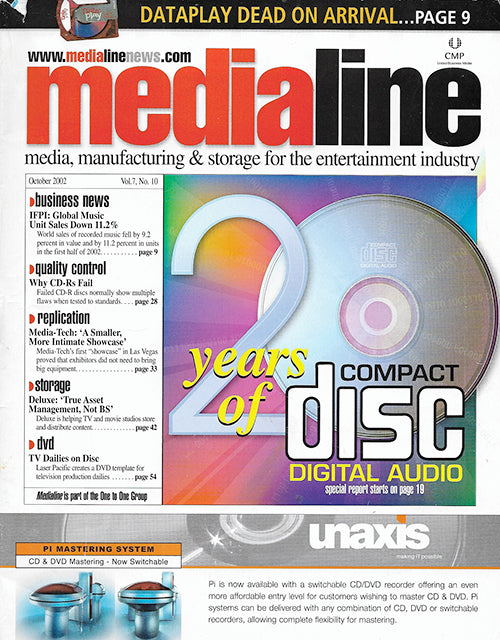
 

Medialine cover noting 20 years of the Compact Disc, October 2002.

Medialine cover noting 20 years of the Compact Disc, October 2002.


Beta vs. VHS vs. Hollywood?

In the mid-1970s, consumer electronics manufacturers Matsushita (Panasonic and Technics) and JVC battled Sony successfully over then-competing home video formats. Actually, the bigger adversary was Hollywood, which fought tooth and nail that the ability of consumers to record off television and play movies in their homes constituted copyright infringement (i.e., intellectual property theft).

The Motion Picture Association of America eventually had to eat crow when the US Supreme Court narrowly agreed 5-4 with the CE folks in the landmark 1984 Sony Corp. of America v. Universal City Studios, Inc. a/k/a “the Betamax case.” The irony of the ruling by the time it was handed down by the high court: VHS was firmly entrenched as the home video standard, not Sony’s Beta. At stake were the decades of royalties for everything from the blank media to the use of the VHS logo.

Home video’s ancillary revenue stream turned out to be a windfall for the movie studios, and saved them from box-office bombs. The best book on this subject is Fast Forward: Hollywood, The Japanese, and the VCR Wars (W.W. Norton & Company, 1987) by James Gardner. The videocassette recorder soon became an indispensable status symbol in households, then simply became ubiquitous.

File under too much, too soon: the aforementioned LaserDisc, introduced as DiscoVision by MCA and later sold by Pioneer and other companies, tanked by 1981. In the next decade, the powers that be were jockeying to revolutionize home entertainment again with DVD-Video, which thankfully took notice of CD’s success, using the same-sized optical disc read by a laser, but more importantly, enjoyed cooperation among multinational corporate parties.

Next-Gen Audio Didn’t Learn from the DVD Lesson

The reason why DVD-Video became the fastest-growing consumer electronics product in history was the unprecedented level of cooperation that existed not only among the Hollywood studios and CE manufacturers but also the computer industry. Sadly, the record industry did not follow this rationale when it stumbled badly to introduce a high-resolution audio format, and instead brought forth the competing formats of DVD-Audio vs. Super Audio CD. No doubt each format’s proponents had an eye on replacing the CD, which was an interesting goal, since DVD-Video had ushered in surround sound in living rooms and home theaters.

But consumers were confused. 20 years ago, even audiophiles didn’t go along with the hype and were weary of the format wars. A Stereophile online poll at the time found that 52 percent of respondents resisted buying either format because they didn’t want to make a choice.
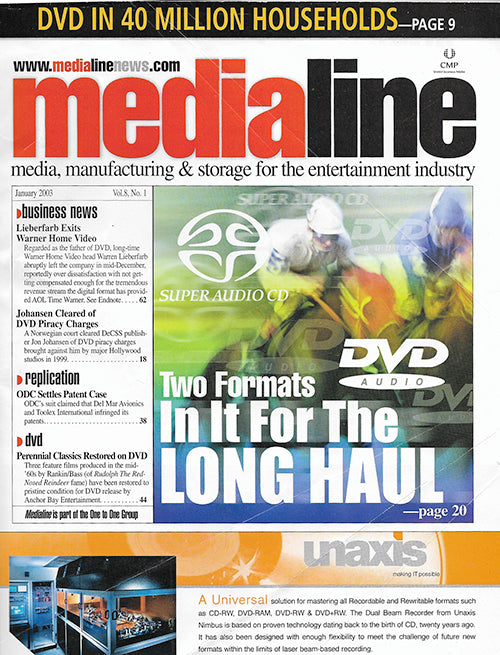
 

Well, one format made it for the long haul. Medialine cover, January 2003.

Well, one format made it for the long haul. Medialine cover, January 2003.


By 2002, CD sales had peaked, with rapid annual declines ahead. Napster and other bit-torrent file sharing had become the zeitgeist, and the blank disc became the best-selling CD of the year. The Recording Industry of America (RIAA) was too busy worrying about Digital Audio Tape (DAT) to realize that computers with built-in optical disc drives would be their downfall. The genie was out of the bottle.

At the October 2004 Audio Engineering Society (AES) convention in San Francisco, Robin Hurley, then senior vice president of A&R for Warner Strategic Marketing, admitted DVD-Audio had been a disaster.

In fact, Hurley said he wouldn’t be surprised if the labels just let whatever stock was on retail shelves sell out. An AES co-panelist added that he had just been on a “reconnaissance mission” to the local Virgin Megastore (now I’m really dating myself, aren’t I?) two blocks away, “and it appeared DVD-Audio was taken off the floor.”

Hurley’s sobering analysis added, “One of the things the industry hasn’t come to grips with is a unified advertising campaign. The biggest thing that hurts us is that there are two formats out there. That really has made executives at the highest level wince and pause before putting big money in it. That wasn’t the case with movies on DVD.”

True, Super Audio CDs are still being made but it’s a niche market, not the replacement for the CD originally envisioned. And interestingly, Blu-ray might have won out over HD-DVD – another confusing format war and a story to be told – but standard DVD-Video discs are still also being produced.

Common sense in the business world – and life for that matter – tells you not to repeat the same mistakes. Hopefully such a philosophy will carry over to future audio formats, even as vinyl continues its astounding resurgence.


Copper contributor Larry Jaffee is author of the book Record Store Day: The Most Improbable Comeback of the 21st Century, and is co-founder/conference director of industry trade organization Making Vinyl. More information is available at www.larryjaffee.com.

Header image: the Sony CDP-101, the first commercially-available CD player. Courtesy of Wikimedia Commons/Atreyu.

More from Issue 175

View All Articles in Issue 175

Search Copper Magazine

Favorites From T.H.E. Show SoCal 2026 by Cam Martin Oct 05, 2026 #235 Singer/Songwriter John David Schrader: On the Need to Create, Part Two by Joe Caplan Oct 05, 2026 #235 A Life in High-End Audio: The Roy Hall Interview, Part Two by Frank Doris Oct 05, 2026 #235 Grammy-Winning Producer, Songwriter, and Guitarist John Leventhal Goes Instrumental With National Drift by Ray Chelstowski Oct 05, 2026 #235 From Swimming Pool to New Listening Room—to Founding an Accidental Audio Company by Gilles Laferrière Oct 05, 2026 #235 The Vinyl Beat’s Size Matters Edition by Rudy Radelic Oct 05, 2026 #235 The Sublime Complexities of Nature by B. Jan Montana Oct 05, 2026 #235 How to Play In a Rock Band, 28: Growing Older and Dealing With It by Frank Doris Oct 05, 2026 #235 Young Rascals: From Bar Band to Stardom by Wayne Robins Oct 05, 2026 #235 Duncan Sheik: In Memoriam by Ray Chelstowski Oct 05, 2026 #235 From The Listening Chair: The Meze Audio 105 Silva Headphones by Howard Kneller Oct 05, 2026 #235 Checking Out Some NOLA Loudspeakers – and Some Thoughts About Audio Writing by Frank Doris Oct 05, 2026 #235 The Kanazawa Phonograph Museum: Music from a Time Capsule by Sebastian Polcyn Oct 05, 2026 #235 PS Audio in the News by PS Audio Staff Oct 05, 2026 #235 From The Audiophile’s Guide: Making the Most Critical Choice by Paul McGowan Oct 05, 2026 #235 Evolutionary Growth by Frank Doris Oct 05, 2026 #235 Speed Racer by Peter Xeni Oct 05, 2026 #235 Happy Halloween! by James Schrimpf Oct 05, 2026 #234 A Life in High-End Audio: The Roy Hall Interview, Part One by Frank Doris Sep 07, 2026 #234 Jason Greenlaw Offers His Personal Perspective on Jazz Guitar in Vantage Point by Frank Doris Sep 07, 2026 #234 Transcendent Phoenix: Lucina Yue Brings the Ancient Konghou Into Modern Times by Frank Doris Sep 07, 2026 #234 We Must All Follow Our Bliss by B. Jan Montana Sep 07, 2026 #234 How to Play in a Rock Band, 27: Leveling Up by Frank Doris Sep 07, 2026 #234 Ross Valory: Traveling Into New Musical Territory With All of the Above by Ray Chelstowski Sep 07, 2026 #234 Singer/Songwriter John David Schrader: On the Need to Create by Joe Caplan Sep 07, 2026 #234 The People Who Make Audio Happen: More From T.H.E. Show SoCal 2026 by Harris Fogel Sep 07, 2026 #234 The Vinyl Beat Digs Into the Gadget Box by Rudy Radelic Sep 07, 2026 #234 The Rolling Stones: Foreign Tongues Spoken Loud by Wayne Robins Sep 07, 2026 #234 Musical Moments by Rich Isaacs Sep 07, 2026 #234 Rags for Solo Piano and a Dog: David Chesky's Ragtime Music for the Modern Age by Frankly Speaking Sep 07, 2026 #234 HIGH END 2026, Vienna: Here to Stay by Carsten Barnbeck Sep 07, 2026 #234 From The Audiophile’s Guide: The Two Main Types of Loudpeakers – Box and Panel by Paul McGowan Sep 07, 2026 #234 Letting it Slide by Frank Doris Sep 07, 2026 #234 PS Audio in the News by PS Audio Staff Sep 07, 2026 #234 Long Playing by Peter Xeni Sep 07, 2026 #234 La Mer by B. Jan Montana Sep 07, 2026 #233 A Report From The Total Hi-Fi Experience Show SoCal 2026 by B. Jan Montana Aug 03, 2026 #233 Bluegrass Meets Country, Folk, Jazz and More in All That We Carried by The Squid City Slingers by Frank Doris Aug 03, 2026 #233 Corey Glover and One Tribe Nation: A Variegated Musical Collective by Ray Chelstowski Aug 03, 2026 #233 Excursions with Clive: The Late Clive Davis, A Personal History by Wayne Robins Aug 03, 2026 #233 AI, Art, and Music: A Conversation With Synthography Art by Joe Caplan Aug 03, 2026 #233 New American Symphonies: A Rediscovered Gem and a Vital Contemporary Work by Frank Doris Aug 03, 2026 #233 The Vinyl Beat: Genesis, the Dave Clark Five, Antonio Carlos Jobim and More by Rudy Radelic Aug 03, 2026 #233 How to Play in a Rock Band, 26: When It's Time to Record Your Music by Frank Doris Aug 03, 2026 #233 More From T.H.E. Show 2026, and the People Who Made it Happen by Harris Fogel Aug 03, 2026 #233 Underappreciated Artists, Part Three: Icehouse by Rich Isaacs Aug 03, 2026 #233 The Surprisingly Rich and Varied Music of Somalia by Steve Kindig Aug 03, 2026

Considering CD’s 40th Birthday

Considering CD’s 40th Birthday

I did not want the Compact Disc’s 40th anniversary to slip by without making a few observations. After all, I covered the format during its peak for Replication News, the CD’s primary trade magazine at the time, at the time, when I was hired in late 1997, and for Medialine until that publication’s demise in 2006.

Acknowledging my love-hate relationship with the CD, I still regularly buy them since they’re so cheap and easy to come by in thrift stores and online sources these days.

In the spring of 1986, when it was considered a state-of-the-art technology, I remember showing off the silver little disc to my students in the popular music course I was co-teaching. The undergraduates didn’t seem much interested, even though they were only about six years younger than me. They were still getting used to MTV, which was the subject of my Master’s project at the time. In one of my bolder classroom moments, I predicted that in a few years’ time they all would be listening to and buying CDs.

Of course, I was not wrong.

Sony introduced the CD first in Japan in February 1982, the beginning of a worldwide revolution that reinvented the record industry, which had been lobbied for several years to go along with the new technology. In fact, the CD’s roots can be said to harken back to 1937 when the idea of pulse code modulation (PCM) was conceived of as a means of audio reproduction. Error detection and correction research emerged in 1950. Then the laser came out of a lab in 1960. In 1967, broadcaster NHK presented a 12-bit digital audio recorder using a 30 kHz sampling rate.


The familiar Compact Disc logo. Courtesy of Wikimedia Commons/Sony and Philips/public domain.

The familiar Compact Disc logo. Courtesy of Wikimedia Commons/Sony and Philips/public domain.


Two years later, Dutch physicist Klaas Compaan shared his concept for the CD. In 1970, Philips Research created a glass-master prototype that initially was designed for its 12-inch Video Long Play laser player, demonstrated to the press in 1972. Philips’ scientists realized that the laser could also read audio signals, and they stepped up their efforts to shrink down the disc size for a consumer product that could store an hour of music.

Meanwhile, around the same time in the US, MCA purchased patents and ended up collaborating with Philips on what eventually became the LaserDisc, which launched in the US in 1978.

The talk at the 1977 Tokyo Audio Show was the digital audio disc prototypes presented by Sony, Hitachi, and Mitsubishi, while 35 manufacturers came to the Digital Audio Convention in Tokyo the next year when Philips proposed that the disc be made out of polycarbonate. In 1979, the first CD player prototypes circulated in Europe and Japan. Later that year, Philips and Sony agreed on a sampling rate of 44.1kHz and 16-bit audio.

One of the reasons the CD succeeded – as did DVD-Video for that matter – was that Sony and Philips, partners in the format’s R&D, checked their egos at the door. They took the best elements of their research to make a better product and create the “Red Book” CD audio standard in 1981. It was a rare moment in the entertainment industry.


Medialine cover noting 20 years of the Compact Disc, October 2002.

Medialine cover noting 20 years of the Compact Disc, October 2002.


Beta vs. VHS vs. Hollywood?

In the mid-1970s, consumer electronics manufacturers Matsushita (Panasonic and Technics) and JVC battled Sony successfully over then-competing home video formats. Actually, the bigger adversary was Hollywood, which fought tooth and nail that the ability of consumers to record off television and play movies in their homes constituted copyright infringement (i.e., intellectual property theft).

The Motion Picture Association of America eventually had to eat crow when the US Supreme Court narrowly agreed 5-4 with the CE folks in the landmark 1984 Sony Corp. of America v. Universal City Studios, Inc. a/k/a “the Betamax case.” The irony of the ruling by the time it was handed down by the high court: VHS was firmly entrenched as the home video standard, not Sony’s Beta. At stake were the decades of royalties for everything from the blank media to the use of the VHS logo.

Home video’s ancillary revenue stream turned out to be a windfall for the movie studios, and saved them from box-office bombs. The best book on this subject is Fast Forward: Hollywood, The Japanese, and the VCR Wars (W.W. Norton & Company, 1987) by James Gardner. The videocassette recorder soon became an indispensable status symbol in households, then simply became ubiquitous.

File under too much, too soon: the aforementioned LaserDisc, introduced as DiscoVision by MCA and later sold by Pioneer and other companies, tanked by 1981. In the next decade, the powers that be were jockeying to revolutionize home entertainment again with DVD-Video, which thankfully took notice of CD’s success, using the same-sized optical disc read by a laser, but more importantly, enjoyed cooperation among multinational corporate parties.

Next-Gen Audio Didn’t Learn from the DVD Lesson

The reason why DVD-Video became the fastest-growing consumer electronics product in history was the unprecedented level of cooperation that existed not only among the Hollywood studios and CE manufacturers but also the computer industry. Sadly, the record industry did not follow this rationale when it stumbled badly to introduce a high-resolution audio format, and instead brought forth the competing formats of DVD-Audio vs. Super Audio CD. No doubt each format’s proponents had an eye on replacing the CD, which was an interesting goal, since DVD-Video had ushered in surround sound in living rooms and home theaters.

But consumers were confused. 20 years ago, even audiophiles didn’t go along with the hype and were weary of the format wars. A Stereophile online poll at the time found that 52 percent of respondents resisted buying either format because they didn’t want to make a choice.


Well, one format made it for the long haul. Medialine cover, January 2003.

Well, one format made it for the long haul. Medialine cover, January 2003.


By 2002, CD sales had peaked, with rapid annual declines ahead. Napster and other bit-torrent file sharing had become the zeitgeist, and the blank disc became the best-selling CD of the year. The Recording Industry of America (RIAA) was too busy worrying about Digital Audio Tape (DAT) to realize that computers with built-in optical disc drives would be their downfall. The genie was out of the bottle.

At the October 2004 Audio Engineering Society (AES) convention in San Francisco, Robin Hurley, then senior vice president of A&R for Warner Strategic Marketing, admitted DVD-Audio had been a disaster.

In fact, Hurley said he wouldn’t be surprised if the labels just let whatever stock was on retail shelves sell out. An AES co-panelist added that he had just been on a “reconnaissance mission” to the local Virgin Megastore (now I’m really dating myself, aren’t I?) two blocks away, “and it appeared DVD-Audio was taken off the floor.”

Hurley’s sobering analysis added, “One of the things the industry hasn’t come to grips with is a unified advertising campaign. The biggest thing that hurts us is that there are two formats out there. That really has made executives at the highest level wince and pause before putting big money in it. That wasn’t the case with movies on DVD.”

True, Super Audio CDs are still being made but it’s a niche market, not the replacement for the CD originally envisioned. And interestingly, Blu-ray might have won out over HD-DVD – another confusing format war and a story to be told – but standard DVD-Video discs are still also being produced.

Common sense in the business world – and life for that matter – tells you not to repeat the same mistakes. Hopefully such a philosophy will carry over to future audio formats, even as vinyl continues its astounding resurgence.


Copper contributor Larry Jaffee is author of the book Record Store Day: The Most Improbable Comeback of the 21st Century, and is co-founder/conference director of industry trade organization Making Vinyl. More information is available at www.larryjaffee.com.

Header image: the Sony CDP-101, the first commercially-available CD player. Courtesy of Wikimedia Commons/Atreyu.

0 comments

Leave a comment

0 Comments

Your avatar

Loading comments...

🗑️ Delete Comment

Enter moderator password to delete this comment:

✏️ Edit Comment

Enter your email to verify ownership: