COPPER

A PS Audio Publication

Issue 169 • Free Online Magazine

Issue 169 Frankly Speaking

Confessions of a Setup Man, Part 15: Avoiding Burnout

Confessions of a Setup Man, Part 15: Avoiding Burnout

We’ve all experienced burnout in one form or another, exacerbated by living in the COVID-19 era. Merriam-Webster defines burnout as “exhaustion of physical and emotional strength or motivation usually as a result of prolonged stress or frustration.”

Audio is supposed to be fun. For some if not most of us, constantly tinkering, upgrading and tweaking our audio systems is rewarding. What sonic improvements will the latest upgrade bring? I’m going to hear my music sound better than before! What a rush! The thrill of taking a new (or vintage, if that’s your thing) component out of the box brings us back to those happy childhood feelings of unwrapping a holiday or birthday gift.

On the other hand, constantly futzing with our systems can get to the point where it becomes tedious and ultimately, stressful. Have you ever gotten to the point where you’re not sure if a change is an improvement…or if you’re even sure you can even hear a change or are just getting more and more confused? (A sure recipe for buyer’s remorse.) Or wonder if you’ll ever be satisfied with the sound of your system (usually after playing your same system-evaluation tracks for the hundredth time), and throw up your hands in frustration?

Yep, sounds like audio system burnout. This can be especially problematic for reviewers and industry professionals who have to constantly change their setups and make sonic evaluations.

How do you know when you’re burning out on audio? The first symptom is obvious: you don’t enjoy listening to your system.

You feel like listening has become a chore rather than a pleasure.

You make excuses to not listen. Your inner voice (don’t you wish you could shut it off sometimes?) says things like, “By the time it’s warmed up, I won’t have much time.” “I’m getting that new preamp next week, so why bother listening now?” “I’ve just worked a 14-hour day and I’m too tired.” (Well, actually, that’s a legitimate excuse.) “I don’t feel good.” “It’s too much trouble.” “I’m not in the mood.”

You don’t play your system for days, weeks, or even months at a time.

You don’t even want to look at your system or be in the same room with it. Literally…walking past your rig induces thoughts like, “I wonder if my azimuth is really correct.” “I really should get around to cleaning the contacts.” “I wish I could get rid of that hum from my turntable.” “Why did I spend all that money?” “Ah, screw it.”

You forget you even own an audio system.

I experienced my most severe case of audio burnout in the mid-1990s in the last few months of working for The Absolute Sound and right after I left. Admittedly, my situation was not typical. I had been setting up Harry Pearson’s systems for around seven years, and we were constantly changing and evaluating components and speakers. At first it was exciting. It became tedious. Then, ultimately, maddening. It got to the point (I’ve noted this previously in Copper) where, one day, I simply could not get the power tubes in an amplifier to bias properly and I went into Harry’s bathroom, locked the door, and almost cried.

In my days at TAS I would usually work in the office in the morning, desperately trying to get a day’s worth of work done in a few hours, until HP would call and summon me to the listening rooms. It was an impossible juggling act…and this was in the days before e-mail. The phone messages would pile up, often more than 20 per day. I felt constantly rushed. The hours were long.

Harry’s work habits were not exactly precision-calibrated. He would wait until the last minute to write his reviews, which meant that the magazine could not be finished until he was done. Sometimes this would be the day the proofs had to be approved. Stress-a-rama with everyone on tenterhooks, especially me, when I worked as managing editor. I will say, though, that Harry was the fastest typist I’ve ever seen. He claimed he was clocked at something like 150 to 170 words per minute. Having seen him in action, I believe it. And he’d have the review pretty much composed in his head, type it out, look it over, make some revisions, and bam! Good to go. Except for that last-minute run to FedEx to deliver the book to the printer, sometimes with only minutes to spare (and I’m not exaggerating for dramatic effect).

At the height of HP’s glory days (and yes, they came to an end, but that’s something I’d rather talk about over a beer, not here, and in spite of all the tsouris, the guy was a friend), we’d get more equipment in than Harry could possibly review. He’d decide not to write about something, having moved onto the next favored-component-of-the-week, when of course the manufacturer was expecting an HP Review (and a major boost in sales). Guess who had to deal with the manufacturer’s ire?

Often, Harry would shuffle the review off to me, and I did not like doing reviews (as noted in Issue 158). So, double stress from getting blasted by rightfully-upset manufacturers, and having to do reviews I didn’t want to have any part of. (I did get to take some great gear home, though.) TAS was having financial issues at the time, which did nothing for my sense of job security, especially since we were starting a family.

Let me interject and note that The Absolute Sound today is a very different organization than the one that I was part of decades ago (jeez, it’s really been decades). They are professionally-run, I know and respect and am friends with most of the people there, and my comments about the way things were have no relationship to the TAS of today.

Ultimately I had to leave. I was at the point where the stress permeated every waking minute. I had gone from loving the music and the gear to desperately wishing I could get away from it. If that’s not audio burnout, I don’t know what is.

******

After I left TAS I didn’t listen to my system for a year.

Once I started listening again, I refused to make any changes to my system. I just didn’t want to hop on the reviewing carousel again.

I kept going to CES, but for some years, didn’t go to see the high-end audio exhibits.
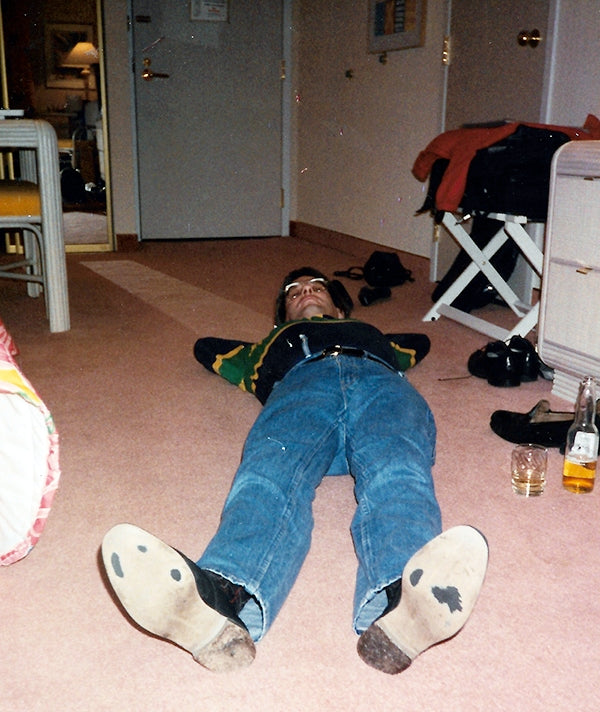
 

The editor after his first Consumer Electronics Show (CES), 1988. Photographer unknown, possibly someone from The Absolute Sound.

The editor after his first Consumer Electronics Show (CES), 1988. Photographer unknown, possibly someone from The Absolute Sound.


So, how did I get back from acute burnout to having renewed enthusiasm – my normal state, just like an electron that wants to go back to its natural orbit? What’s my advice?

I’ve already implied it, which is perhaps all too obvious. Walk away.

Just walk away from your system for a while. Don’t think about the fact that you even have one. Leave the VTA tweaking, experimenting with different digital gear, speaker placement tweaks, tube rolling and all that stuff aside. If you’re like me, eventually, the desire to hear your music at its best – the reason that got all of us into high-end audio – will come back. When it does, you’ll be listening with fresh ears.

Go see some live music. Admittedly, this was impossible for a while, but it’s becoming (knock on wood) safer now. It will recalibrate your ears and enable you to listen to your system with a fresh perspective.

Sometimes, a system can be “too good.” (See my article in Issue 127). You expect it to sound miraculous, and strain over listening for every sonic detail. A “lesser” system can actually be psychologically easier to listen to. (Of course, when you hear a really awe-inspiring rig, this argument falls apart.) And, some of us simply can’t afford anything more than a modest system. Problem solved!

On the other hand, life isn’t getting any longer. As I’ve noted before, maybe it is time to get that component or those speakers you’ve been dreaming of. I know that if I got myself an X amp or Y speakers, I’d be rushing to get to the listening chair.

A little aside might be in order: when you make a component change or a tweak, give it some time. Don’t make a snap judgment. Equipment can need break-in, sometimes a lot. I remember when I changed an amplifier – after I had sold the previous one – and was crushed by the fact that I thought I’d made an irrevocable mistake. The new amp sounded brighter and flatter. 100 hours later, the new amp blossomed, and crushed the old one.

Invite your significant other and family and friends to listen with you. All too often, audio is a solitary pursuit. But sharing favorite music or watching the reactions of a non-audiophile friend as they’re blown away by the sound of your rig is fun. Make it a party!

Seek out new music. Don’t listen to the same 10 demo tracks all the time. There’s so much out there, and streaming is the gateway to musical infinity.

Most of all: put things in perspective. Don’t take your music and your system for granted. Time is our most precious commodity. Make time to hear the magic.


Header image courtesy of Pixabay.com/Gerd Altmann.

More from Issue 169

View All Articles in Issue 169

Search Copper Magazine

#225 Capital Audiofest 2025: Must-See Stereo, Part One by Frank Doris Dec 01, 2025 #225 Otis Taylor and the Electrics Delivers a Powerful Set of Hypnotic Modern Blues by Frank Doris Dec 01, 2025 #225 A Christmas Miracle by B. Jan Montana Dec 01, 2025 #225 T.H.E. Show New York 2025, Part Two: Plenty to See, Hear, and Enjoy by Frank Doris Dec 01, 2025 #225 Underappreciated Artists, Part One: Martin Briley by Rich Isaacs Dec 01, 2025 #225 Rock and Roll is Here to Stay by Wayne Robins Dec 01, 2025 #225 A Lifetime of Holiday Record (and CD) Listening by Rudy Radelic Dec 01, 2025 #225 Little Feat: Not Saying Goodbye, Not Yet by Ray Chelstowski Dec 01, 2025 #225 How to Play in a Rock Band, Part 18: Dealing With Burnout by Frank Doris Dec 01, 2025 #225 The People Who Make Audio Happen: CanJam SoCal 2025 by Harris Fogel Dec 01, 2025 #225 Chicago’s Sonic Sanctuaries: Four Hi‑Fi Listening Bars Channeling the Jazz‑Kissa Spirit by Olivier Meunier-Plante Dec 01, 2025 #225 From The Audiophile’s Guide: Controlling Bass Frequencies Through Membrane Absorbers (and How to Build Your Own) by Paul McGowan Dec 01, 2025 #225 Your Editor’s Tips for Attending Audio Shows by Frank Doris Dec 01, 2025 #225 PS Audio in the News by Frank Doris Dec 01, 2025 #225 Back to My Reel-to-Reel Roots, Part 24 by Ken Kessler Dec 01, 2025 #225 Holiday Music by Frank Doris Dec 01, 2025 #225 Puppy Prognostication by Peter Xeni Dec 01, 2025 #225 How to Post Comments on Copper by Frank Doris Dec 01, 2025 #225 Living Color by Rudy Radelic Dec 01, 2025 #224 T.H.E. Show New York 2025, Part One: A New Beginning by Frank Doris Nov 03, 2025 #224 Fool’s Leap of Faith is the Extraordinary Octave Records Debut from Singer/Songwriter Tyler Burba and Visit by Frank Doris Nov 03, 2025 #224 The Beatles’ “Aeolian Cadences.” What? by Wayne Robins Nov 03, 2025 #224 Persona Non Grata by B. Jan Montana Nov 03, 2025 #224 Talking With Recording Engineer Barry Diament of Soundkeeper Recordings, Part Two by Frank Doris Nov 03, 2025 #224 B Sides, B Movies, and Beware of Zombies by Rudy Radelic Nov 03, 2025 #224 The Burn-In Chronicles: 1,000 Hours to Sonic Salvation by Olivier Meunier-Plante Nov 03, 2025 #224 A Conversation With Mat Weisfeld of VPI Industries by Joe Caplan Nov 03, 2025 #224 Blues-Rocker Kenny Wayne Shepherd Celebrates 30 Years of Ledbetter Heights by Ray Chelstowski Nov 03, 2025 #224 Playing in a Rock Band, 17: When Good Gigs Go Bad, Part Two by Frank Doris Nov 03, 2025 #224 From The Audiophile’s Guide: Dealing with Odd-Shaped Rooms by Paul McGowan Nov 03, 2025 #224 TEAC’s TN-3B-SE Turntable Plays Bob Dylan by Howard Kneller Nov 03, 2025 #224 PS Audio in the News by Frank Doris Nov 03, 2025 #224 Lost in Translation by Peter Xeni Nov 03, 2025 #224 Reel-to-Reel Roots, Part 23: Better Than Rice Krispies by Ken Kessler Nov 03, 2025 #224 I Bring Joy! by Frank Doris Nov 03, 2025 #224 Screen Test by Rich Isaacs Nov 03, 2025 #224 How to Post Comments on Copper by Frank Doris Nov 03, 2025 #132 Dr. Patrick Gleeson: The Interview, Part Two by Rich Isaacs Oct 07, 2025 #223 World Fusion Meets Flamenco in Gratitude from Steve Mullins and Rim of the Well by Frank Doris Oct 06, 2025 #223 Judging Albums by Their Covers by Rich Isaacs Oct 06, 2025 #223 Recent Arrivals and 12-inch Royalty by Rudy Radelic Oct 06, 2025 #223 Summer of Creem, Part Two by Wayne Robins Oct 06, 2025 #223 Recording Engineer Barry Diament of Soundkeeper Recordings: Striving for Natural Sound by Frank Doris Oct 06, 2025 #223 Tea on the Terrace by B. Jan Montana Oct 06, 2025 #223 How Good Can Car Audio Get? by Joe Caplan Oct 06, 2025 #223 The Advantages of a Dedicated Listening Room by Paul McGowan Oct 06, 2025 #223 1! 2! 3! 4! Surrounded by the Ramones in Dolby Atmos! by Frank Doris Oct 06, 2025

Confessions of a Setup Man, Part 15: Avoiding Burnout

Confessions of a Setup Man, Part 15: Avoiding Burnout

We’ve all experienced burnout in one form or another, exacerbated by living in the COVID-19 era. Merriam-Webster defines burnout as “exhaustion of physical and emotional strength or motivation usually as a result of prolonged stress or frustration.”

Audio is supposed to be fun. For some if not most of us, constantly tinkering, upgrading and tweaking our audio systems is rewarding. What sonic improvements will the latest upgrade bring? I’m going to hear my music sound better than before! What a rush! The thrill of taking a new (or vintage, if that’s your thing) component out of the box brings us back to those happy childhood feelings of unwrapping a holiday or birthday gift.

On the other hand, constantly futzing with our systems can get to the point where it becomes tedious and ultimately, stressful. Have you ever gotten to the point where you’re not sure if a change is an improvement…or if you’re even sure you can even hear a change or are just getting more and more confused? (A sure recipe for buyer’s remorse.) Or wonder if you’ll ever be satisfied with the sound of your system (usually after playing your same system-evaluation tracks for the hundredth time), and throw up your hands in frustration?

Yep, sounds like audio system burnout. This can be especially problematic for reviewers and industry professionals who have to constantly change their setups and make sonic evaluations.

How do you know when you’re burning out on audio? The first symptom is obvious: you don’t enjoy listening to your system.

You feel like listening has become a chore rather than a pleasure.

You make excuses to not listen. Your inner voice (don’t you wish you could shut it off sometimes?) says things like, “By the time it’s warmed up, I won’t have much time.” “I’m getting that new preamp next week, so why bother listening now?” “I’ve just worked a 14-hour day and I’m too tired.” (Well, actually, that’s a legitimate excuse.) “I don’t feel good.” “It’s too much trouble.” “I’m not in the mood.”

You don’t play your system for days, weeks, or even months at a time.

You don’t even want to look at your system or be in the same room with it. Literally…walking past your rig induces thoughts like, “I wonder if my azimuth is really correct.” “I really should get around to cleaning the contacts.” “I wish I could get rid of that hum from my turntable.” “Why did I spend all that money?” “Ah, screw it.”

You forget you even own an audio system.

I experienced my most severe case of audio burnout in the mid-1990s in the last few months of working for The Absolute Sound and right after I left. Admittedly, my situation was not typical. I had been setting up Harry Pearson’s systems for around seven years, and we were constantly changing and evaluating components and speakers. At first it was exciting. It became tedious. Then, ultimately, maddening. It got to the point (I’ve noted this previously in Copper) where, one day, I simply could not get the power tubes in an amplifier to bias properly and I went into Harry’s bathroom, locked the door, and almost cried.

In my days at TAS I would usually work in the office in the morning, desperately trying to get a day’s worth of work done in a few hours, until HP would call and summon me to the listening rooms. It was an impossible juggling act…and this was in the days before e-mail. The phone messages would pile up, often more than 20 per day. I felt constantly rushed. The hours were long.

Harry’s work habits were not exactly precision-calibrated. He would wait until the last minute to write his reviews, which meant that the magazine could not be finished until he was done. Sometimes this would be the day the proofs had to be approved. Stress-a-rama with everyone on tenterhooks, especially me, when I worked as managing editor. I will say, though, that Harry was the fastest typist I’ve ever seen. He claimed he was clocked at something like 150 to 170 words per minute. Having seen him in action, I believe it. And he’d have the review pretty much composed in his head, type it out, look it over, make some revisions, and bam! Good to go. Except for that last-minute run to FedEx to deliver the book to the printer, sometimes with only minutes to spare (and I’m not exaggerating for dramatic effect).

At the height of HP’s glory days (and yes, they came to an end, but that’s something I’d rather talk about over a beer, not here, and in spite of all the tsouris, the guy was a friend), we’d get more equipment in than Harry could possibly review. He’d decide not to write about something, having moved onto the next favored-component-of-the-week, when of course the manufacturer was expecting an HP Review (and a major boost in sales). Guess who had to deal with the manufacturer’s ire?

Often, Harry would shuffle the review off to me, and I did not like doing reviews (as noted in Issue 158). So, double stress from getting blasted by rightfully-upset manufacturers, and having to do reviews I didn’t want to have any part of. (I did get to take some great gear home, though.) TAS was having financial issues at the time, which did nothing for my sense of job security, especially since we were starting a family.

Let me interject and note that The Absolute Sound today is a very different organization than the one that I was part of decades ago (jeez, it’s really been decades). They are professionally-run, I know and respect and am friends with most of the people there, and my comments about the way things were have no relationship to the TAS of today.

Ultimately I had to leave. I was at the point where the stress permeated every waking minute. I had gone from loving the music and the gear to desperately wishing I could get away from it. If that’s not audio burnout, I don’t know what is.

******

After I left TAS I didn’t listen to my system for a year.

Once I started listening again, I refused to make any changes to my system. I just didn’t want to hop on the reviewing carousel again.

I kept going to CES, but for some years, didn’t go to see the high-end audio exhibits.


The editor after his first Consumer Electronics Show (CES), 1988. Photographer unknown, possibly someone from The Absolute Sound.

The editor after his first Consumer Electronics Show (CES), 1988. Photographer unknown, possibly someone from The Absolute Sound.


So, how did I get back from acute burnout to having renewed enthusiasm – my normal state, just like an electron that wants to go back to its natural orbit? What’s my advice?

I’ve already implied it, which is perhaps all too obvious. Walk away.

Just walk away from your system for a while. Don’t think about the fact that you even have one. Leave the VTA tweaking, experimenting with different digital gear, speaker placement tweaks, tube rolling and all that stuff aside. If you’re like me, eventually, the desire to hear your music at its best – the reason that got all of us into high-end audio – will come back. When it does, you’ll be listening with fresh ears.

Go see some live music. Admittedly, this was impossible for a while, but it’s becoming (knock on wood) safer now. It will recalibrate your ears and enable you to listen to your system with a fresh perspective.

Sometimes, a system can be “too good.” (See my article in Issue 127). You expect it to sound miraculous, and strain over listening for every sonic detail. A “lesser” system can actually be psychologically easier to listen to. (Of course, when you hear a really awe-inspiring rig, this argument falls apart.) And, some of us simply can’t afford anything more than a modest system. Problem solved!

On the other hand, life isn’t getting any longer. As I’ve noted before, maybe it is time to get that component or those speakers you’ve been dreaming of. I know that if I got myself an X amp or Y speakers, I’d be rushing to get to the listening chair.

A little aside might be in order: when you make a component change or a tweak, give it some time. Don’t make a snap judgment. Equipment can need break-in, sometimes a lot. I remember when I changed an amplifier – after I had sold the previous one – and was crushed by the fact that I thought I’d made an irrevocable mistake. The new amp sounded brighter and flatter. 100 hours later, the new amp blossomed, and crushed the old one.

Invite your significant other and family and friends to listen with you. All too often, audio is a solitary pursuit. But sharing favorite music or watching the reactions of a non-audiophile friend as they’re blown away by the sound of your rig is fun. Make it a party!

Seek out new music. Don’t listen to the same 10 demo tracks all the time. There’s so much out there, and streaming is the gateway to musical infinity.

Most of all: put things in perspective. Don’t take your music and your system for granted. Time is our most precious commodity. Make time to hear the magic.


Header image courtesy of Pixabay.com/Gerd Altmann.

0 comments

Leave a comment

0 Comments

Your avatar

Loading comments...

🗑️ Delete Comment

Enter moderator password to delete this comment: