COPPER

A PS Audio Publication

Issue 149 • Free Online Magazine

Issue 149 EUREKA MOMENTS

Building My First System

Building My First System

In the 1950s, TV sets had lousy pictures – but some of them had rather good sound. Our 16-inch RCA TV (“that big screen in a 12 x 12-foot room?” said the neighbors; “you’ll go blind!”) showed images only in black and white, of course, with a 525-line vertical resolution (up to 486 of those lines visible) and about 440 pixels horizontally – about one-tenth the resolution of a 1080p digital TV. But the RCA had a wood, floor-standing cabinet, with an 8-inch speaker baffled on all sides except the back. Since all else we had were two Emerson AM radios, it had the best sound in the house.

And our TV had an audio input jack on the rear panel – RCA’s way of encouraging sales of the Victrola Attachment 45 rpm record changer, the company’s answer to the LP system Columbia Records had introduced a year or two before.

RCA Victor 16-inch TV.

Aged 11, I’d been listening to our AM radios, largely to classical music from distant New York City. But with one of those little changers and some records, I could hear music of my choice whenever I wanted to. And, at $12.95 (including six records!) I could afford it from banked birthday money my parents hadn’t let me spend. I got Dad to break $25 loose from my savings account, and scampered down to Conn’s Record Shop on Church Street.

And what a haul! The RCA player, of course, plus Mario Lanza’s Great Caruso album (I wanted to sing like that tenor back then, though still a soprano at the time), a single by Caruso himself, one Spike Jones single, three Phil Harris discs, and another record or two that I’ve forgotten.

I wasn’t an audiophile yet, but I had two audiophile traits – a love of music and the urge to make improvements. The first one, at my urging but on Dad’s nickel, was to replace the 45-only changer with a Webcor 3-speed model, so we could play LPs, too. The second, once I’d been introduced to hi-fi by my high school chem teacher, was to replace the TV’s 8-inch driver with a $10 Lafayette SK-98 whose cone had a hardened center section for better highs. (I’ve heard since that it was made by Pioneer.) Rated response was “40 – 16,000 cycles per second,” numbers that meant nothing to me at the time.

That sufficed until I went off to Yale, and had to leave our TV console home. I bought a small, $15 ported enclosure from Lafayette, and a used Realistic 10- or 12-watt amplifier (built by Grommes) for $10 from my girlfriend’s father. I progressed from there to a used 25-watt Heathkit W5M amp and model WA-P2 preamp that took its power from an octal socket on the amp. The preamp’s main feature was selectable turnover and rolloff frequencies, to deal with the many company-specific record-equalization curves then prevalent; the RIAA curve was already in use, but there were still a lot of older discs out there. (Unfortunately, I couldn’t use that selectable EQ, because the Webcor had a ceramic cartridge that didn’t require equalization.) I also moved the Lafayette speaker to an RJ enclosure that I got cheap because the foam surround of the RJ’s original Wharfedale driver had rotted out.


Heathkit WA-P2 preamplifier.

Heathkit WA-P2 preamplifier.

Sophomore year, I roomed with guys who wanted something fancier, and in new-fangled stereo. Rather than pool our money for a jointly-owned system we’d have to sell off when we went our separate ways, we each bought one system component. I don’t recall what speakers we wound up with (AR-1s?), but I know we had a sleek-looking Fairchild arm, cartridge, and belt-drive turntable, plus an H.H. Scott stereo preamp and H.H. Scott 330 “binaural” tuner. The 330 had independent AM and FM tuner sections and dials, to take advantage of “simulcast” stereo with one channel on AM and one on FM. (Alas, the only station doing that near us was WQXR, in New York; since that was 80 miles away, we could only get the AM part.) To round out the system, we had two Dynaco Mk. III 60-watt amps.


Dynaco MK III amplifier schematic diagram.

Getting the amps was my job. Having very little money, I researched the hell out of my selection, to make sure I got maximum value. I’d hoped to find a book that would explain it all to me, but couldn’t, and resolved someday to write that book myself (which eventually led to my career in audio).

I took the next year off, living and working in New York. While there, I bought and built my first kit, an Eico HFT-90 FM tuner; its dial pointer glowed green in a pattern like an exclamation point that narrowed when you hit a station frequency. My dealer for that, Audio Workshop, not only sold kits but provided tools, bench space, supervision, and technical assistance, plus lockers where you could keep partly finished kits between sessions. Their technical assistance came in handy when I turned the Eico on and got smoke; I’d been supposed to wire pin 1 of one tube to pin 2 and pin 2 to pin 3; but then I went on to wire pin 3 to pin 4, too.

I noticed the Webcor had a two-position tracking force selector, a spring that could be moved from one hole to another. Having heard about the virtues of low tracking force, I moved it to its lower setting, then bought a stylus-force gauge to check the results. The gauge read up to 20 grams, but when I put the Webcor’s tone arm on it, it bottomed with a “clunk!” So, I replaced the Webcor: I got a Dynaco/B&O Stereodyne arm/cartridge that tracked at a then-remarkable 2 grams, and mounted it to a Weathers kit turntable.

Component turntables of the day had massive platters whose flywheel effect added speed stability. (The Fairchild, though, was available with an electronic speed control system.) Many, such as the popular Rek-O-Kut, had idler drives that interposed a rubber wheel between the motor shaft and the platter’s rim to gear the motor’s speed down. To provide the torque those heavy platters needed, the idler had to be heavy and stiff, and unless it was moved away from the motor shaft and platter when the turntable was off, the idler would develop flat spots, leading to thumps and speed irregularities in playback.
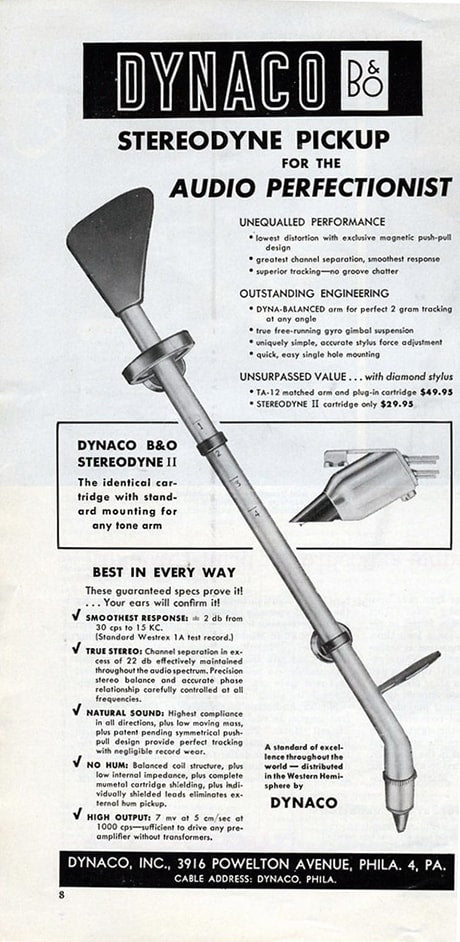
Dynaco/B&O pickup arm. Dynaco/B&O pickup arm.

The Weathers did it differently. Its speed was regulated by a motor much like an electric clock’s. Since such motors had little torque, the platter had to be a light aluminum stamping. And since the torque involved was so small, the idler wheel could be of rubber too soft to develop flat spots – so there was no need for mechanisms to move it out of the way when the turntable was off. Simple. And therefore very, very cheap – just $50, as I recall.

Switching from the Webcor’s ceramic cartridge to the Dyna/B&O magnetic one called for a preamp. I could have used my Heathkit, since my Dyna amps also had sockets that could power it, but I was so close to having stereo I switched to a Dynakit stereo preamp. Click here to view the Dynaco PAS-2 assembly and owners manual.

Then, since I already had those two Dyna amps, all I needed was a second speaker. Another Audio Workshop customer sold me a working RJ Wharfedale, which I temporarily paired with my RJ-housed Lafayette speaker until I could get a matching Wharfedale driver. Now my first real stereo system was a-a-l-most complete. A few months later, I swapped the Eico tuner for a Magnecord PT-6 mono tape recorder whose transport had been taken apart. With the aid of a Sams Photofact service manual, one of my former roommates put it back together for me.
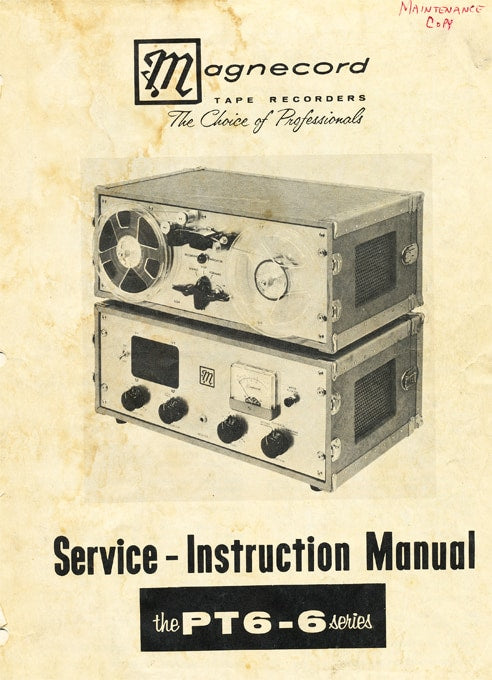
Magnecord PT-6 service and instruction manual. Magnecord PT-6 service and instruction manual.

And that was that.

For a year or so, anyway…

Header image: Eico HFT-90 FM tuner, courtesy of Wikimedia Commons/Joe Haupt.


More from Issue 149

View All Articles in Issue 149

Search Copper Magazine

#231 Piano Prodigy Jude Kofie Releases His Debut Album On Octave Records by Frank Doris Jun 01, 2026 #231 Underappreciated Artists, Part Two: City Boy by Rich Isaacs Jun 01, 2026 #231 Music and the Art of Creation: Talking With Saxophonist Rob Scheps by Joe Caplan Jun 01, 2026 #231 How to Play in a Rock Band, 24: Further Adventures at the 2026 Montauk Music Festival by Frank Doris Jun 01, 2026 #231 Courtney Barnett: Creature of Habit by Wayne Robins Jun 01, 2026 #231 Angine de Poitrine: Interstellar Guitar Rock Saviors Headed for Late-Night TV Pop Stardom? by Mark Lepage Jun 01, 2026 #231 My Impressions of AXPONA 2026, Part One by Frank Doris Jun 01, 2026 #231 2026 La Jolla Concours d'Elegance: Another Aesthetic Feast by B. Jan Montana Jun 01, 2026 #231 Country Music Icon Jo Dee Messina’s Bridges: A New Beginning by Ray Chelstowski Jun 01, 2026 #231 The Luxury Dispatch Hosts a Video Podcast With Ken Kessler by Ken Kessler Jun 01, 2026 #231 The Vinyl Beat: Tracking in the Motor City by Rudy Radelic Jun 01, 2026 #231 Lots of Fun With DSP: The Ferrum Audio WANDLA DAC and Its Tube Mode by Frank Doris Jun 01, 2026 #231 From The Audiophile's Guide: Digital Source Components and Streaming Audio by Paul McGowan Jun 01, 2026 #231 Onkyo’s Monster M-510 power amplifier by The Staff at Just Audio Jun 01, 2026 #231 PS Audio in the News by PS Audio Staff Jun 01, 2026 #231 Naming Convention by Peter Xeni Jun 01, 2026 #231 Les Invisibles by Frank Doris Jun 01, 2026 #231 Wildlife Scene by James Schrimpf Jun 01, 2026 #230 Camaraderie by B. Jan Montana May 04, 2026 #230 AXPONA 2026: A Family Gathering by Paul McGowan May 04, 2026 #230 Pianist Ryan Benthall Explores Jazz Realms and Far Beyond With Divine Sky by Frank Doris May 04, 2026 #230 The Vinyl Beat in AXPONA-Land by Rudy Radelic May 04, 2026 #230 Teddy Thompson’s Musical Growth Deepens With Never Be the Same by Ray Chelstowski May 04, 2026 #230 More Fun in the Sun: Florida Audio Expo, Part Two by Frank Doris May 04, 2026 #230 CanJam NYC 2026 Show Report: Heady Sound, Part Two by Frank Doris and Harris Fogel May 04, 2026 #230 Sonic Youth On Murray Street by Wayne Robins May 04, 2026 #230 Graffeo Coffee: A Symphony of Sensory Experience by Joe Caplan May 04, 2026 #230 The Saul Authority: The Story of Hi-Fi Pioneer Saul Marantz by Olivier Meunier-Plante May 04, 2026 #230 How to Play in a Rock Band, 23: Encounters With Famous Musicians, Part Two by Frank Doris May 04, 2026 #230 An Outlier in the Rack: A Vintage BIC Beam Box by The Staff at Just Audio May 04, 2026 #230 PS Audio in the News by PS Audio Staff May 04, 2026 #230 A Cautionary Tale by Rich Isaacs May 04, 2026 #230 Reel-to-Reel Roots, Part 33 (Revised): Ken Kessler Reports On the 2026 (British) AudioJumble by Ken Kessler May 04, 2026 #230 Text Messaging by Frank Doris May 04, 2026 #230 The Audiophile Rat Race by Peter Xeni May 04, 2026 #230 On the Rocks by Rich Isaacs May 04, 2026 #229 The Earliest Stars of Country Music, Part Three by Jeff Weiner Apr 06, 2026 #229 The Healing Power of Music and Sound at the Omega Institute by Joe Caplan Apr 06, 2026 #229 CanJam NYC 2026 Show Report: Heady Sound, Part One by Frank Doris Apr 06, 2026 #229 Florida Audio Expo 2026: Warming Up to High-End Audio, Part One by Frank Doris Apr 06, 2026 #229 Quick Takes: Anne Bisson, Sam Morrison, The Velvet Underground, and the Stooges by Frank Doris Apr 06, 2026 #229 The Vinyl Beat: New Arrivals, and Old Audio Show Demo Scores to Settle by Rudy Radelic Apr 06, 2026 #229 Harvard Gets a High-End Audio Education by Frank Doris Apr 06, 2026 #229 No Country for Old Knees by B. Jan Montana Apr 06, 2026 #229 How To Play in A Rock Band, 22: Encounters With Famous Musicians, Part 1 by Frank Doris Apr 06, 2026 #229 The Soulful Grooves of Guinea-Bissau by Steve Kindig Apr 06, 2026 #229 Four-Hand Piano Performance at Its Finest by Stephan Haberthür Apr 06, 2026

Building My First System

Building My First System

In the 1950s, TV sets had lousy pictures – but some of them had rather good sound. Our 16-inch RCA TV (“that big screen in a 12 x 12-foot room?” said the neighbors; “you’ll go blind!”) showed images only in black and white, of course, with a 525-line vertical resolution (up to 486 of those lines visible) and about 440 pixels horizontally – about one-tenth the resolution of a 1080p digital TV. But the RCA had a wood, floor-standing cabinet, with an 8-inch speaker baffled on all sides except the back. Since all else we had were two Emerson AM radios, it had the best sound in the house.

And our TV had an audio input jack on the rear panel – RCA’s way of encouraging sales of the Victrola Attachment 45 rpm record changer, the company’s answer to the LP system Columbia Records had introduced a year or two before.

RCA Victor 16-inch TV.

Aged 11, I’d been listening to our AM radios, largely to classical music from distant New York City. But with one of those little changers and some records, I could hear music of my choice whenever I wanted to. And, at $12.95 (including six records!) I could afford it from banked birthday money my parents hadn’t let me spend. I got Dad to break $25 loose from my savings account, and scampered down to Conn’s Record Shop on Church Street.

And what a haul! The RCA player, of course, plus Mario Lanza’s Great Caruso album (I wanted to sing like that tenor back then, though still a soprano at the time), a single by Caruso himself, one Spike Jones single, three Phil Harris discs, and another record or two that I’ve forgotten.

I wasn’t an audiophile yet, but I had two audiophile traits – a love of music and the urge to make improvements. The first one, at my urging but on Dad’s nickel, was to replace the 45-only changer with a Webcor 3-speed model, so we could play LPs, too. The second, once I’d been introduced to hi-fi by my high school chem teacher, was to replace the TV’s 8-inch driver with a $10 Lafayette SK-98 whose cone had a hardened center section for better highs. (I’ve heard since that it was made by Pioneer.) Rated response was “40 – 16,000 cycles per second,” numbers that meant nothing to me at the time.

That sufficed until I went off to Yale, and had to leave our TV console home. I bought a small, $15 ported enclosure from Lafayette, and a used Realistic 10- or 12-watt amplifier (built by Grommes) for $10 from my girlfriend’s father. I progressed from there to a used 25-watt Heathkit W5M amp and model WA-P2 preamp that took its power from an octal socket on the amp. The preamp’s main feature was selectable turnover and rolloff frequencies, to deal with the many company-specific record-equalization curves then prevalent; the RIAA curve was already in use, but there were still a lot of older discs out there. (Unfortunately, I couldn’t use that selectable EQ, because the Webcor had a ceramic cartridge that didn’t require equalization.) I also moved the Lafayette speaker to an RJ enclosure that I got cheap because the foam surround of the RJ’s original Wharfedale driver had rotted out.


Heathkit WA-P2 preamplifier.

Heathkit WA-P2 preamplifier.

Sophomore year, I roomed with guys who wanted something fancier, and in new-fangled stereo. Rather than pool our money for a jointly-owned system we’d have to sell off when we went our separate ways, we each bought one system component. I don’t recall what speakers we wound up with (AR-1s?), but I know we had a sleek-looking Fairchild arm, cartridge, and belt-drive turntable, plus an H.H. Scott stereo preamp and H.H. Scott 330 “binaural” tuner. The 330 had independent AM and FM tuner sections and dials, to take advantage of “simulcast” stereo with one channel on AM and one on FM. (Alas, the only station doing that near us was WQXR, in New York; since that was 80 miles away, we could only get the AM part.) To round out the system, we had two Dynaco Mk. III 60-watt amps.


Dynaco MK III amplifier schematic diagram.

Getting the amps was my job. Having very little money, I researched the hell out of my selection, to make sure I got maximum value. I’d hoped to find a book that would explain it all to me, but couldn’t, and resolved someday to write that book myself (which eventually led to my career in audio).

I took the next year off, living and working in New York. While there, I bought and built my first kit, an Eico HFT-90 FM tuner; its dial pointer glowed green in a pattern like an exclamation point that narrowed when you hit a station frequency. My dealer for that, Audio Workshop, not only sold kits but provided tools, bench space, supervision, and technical assistance, plus lockers where you could keep partly finished kits between sessions. Their technical assistance came in handy when I turned the Eico on and got smoke; I’d been supposed to wire pin 1 of one tube to pin 2 and pin 2 to pin 3; but then I went on to wire pin 3 to pin 4, too.

I noticed the Webcor had a two-position tracking force selector, a spring that could be moved from one hole to another. Having heard about the virtues of low tracking force, I moved it to its lower setting, then bought a stylus-force gauge to check the results. The gauge read up to 20 grams, but when I put the Webcor’s tone arm on it, it bottomed with a “clunk!” So, I replaced the Webcor: I got a Dynaco/B&O Stereodyne arm/cartridge that tracked at a then-remarkable 2 grams, and mounted it to a Weathers kit turntable.

Component turntables of the day had massive platters whose flywheel effect added speed stability. (The Fairchild, though, was available with an electronic speed control system.) Many, such as the popular Rek-O-Kut, had idler drives that interposed a rubber wheel between the motor shaft and the platter’s rim to gear the motor’s speed down. To provide the torque those heavy platters needed, the idler had to be heavy and stiff, and unless it was moved away from the motor shaft and platter when the turntable was off, the idler would develop flat spots, leading to thumps and speed irregularities in playback.

Dynaco/B&O pickup arm. Dynaco/B&O pickup arm.

The Weathers did it differently. Its speed was regulated by a motor much like an electric clock’s. Since such motors had little torque, the platter had to be a light aluminum stamping. And since the torque involved was so small, the idler wheel could be of rubber too soft to develop flat spots – so there was no need for mechanisms to move it out of the way when the turntable was off. Simple. And therefore very, very cheap – just $50, as I recall.

Switching from the Webcor’s ceramic cartridge to the Dyna/B&O magnetic one called for a preamp. I could have used my Heathkit, since my Dyna amps also had sockets that could power it, but I was so close to having stereo I switched to a Dynakit stereo preamp. Click here to view the Dynaco PAS-2 assembly and owners manual.

Then, since I already had those two Dyna amps, all I needed was a second speaker. Another Audio Workshop customer sold me a working RJ Wharfedale, which I temporarily paired with my RJ-housed Lafayette speaker until I could get a matching Wharfedale driver. Now my first real stereo system was a-a-l-most complete. A few months later, I swapped the Eico tuner for a Magnecord PT-6 mono tape recorder whose transport had been taken apart. With the aid of a Sams Photofact service manual, one of my former roommates put it back together for me.

Magnecord PT-6 service and instruction manual. Magnecord PT-6 service and instruction manual.

And that was that.

For a year or so, anyway…

Header image: Eico HFT-90 FM tuner, courtesy of Wikimedia Commons/Joe Haupt.


0 comments

Leave a comment

0 Comments

Your avatar

Loading comments...

🗑️ Delete Comment

Enter moderator password to delete this comment:

✏️ Edit Comment

Enter your email to verify ownership: