COPPER

A PS Audio Publication

Issue 171 • Free Online Magazine

Issue 171 Speaker Stories

Audio Nirvana (I Found It!)

Audio Nirvana (I Found It!)

A little background: the first article I wrote for Copper back in 2019 was about a speaker demonstration at the home of the late designer and engineer Siegfried Linkwitz (“A Visit to a Linkwitz Open House,” Issue 92). Years before, I had the privilege of paying a visit while Siegfried was still alive. He was a gracious and unpretentious man who gave freely of his time, although he did not know me before I requested an audition. After he passed away in 2018, Dr. Frank Brenner, under the company name of EarFood GmbH took over the manufacture and promotion of Siegfried’s speaker designs as well as presenting demos at the Linkwitz home and other locations. Prior to that, Siegfried had sold only plans for DIY builders, and the Madisound company sold the SEAS driver complement along with a flat pack of cabinet materials for the adventurous to build themselves. Siegfried never got into manufacturing. The Madisound driver kits are still available, but the flat pack is currently out of stock.

I had contributed a number of photos to the “Parting Shot” feature, but hadn’t written anything for the magazine. Former editor Bill Leebens was going to be in my neck of the woods to cover the California Audio Show. I was looking forward to meeting him, and I let him know about a demonstration of the Linkwitz LX521.4 speakers that was occurring the same weekend. I asked if he would like to attend, but he said he would be too busy covering the show. When I proposed writing a report on the event myself, he thought that would be fine.

I didn’t consider becoming a regular contributor until Frank Doris took over as editor. One of his first actions was to reach out to all who had written for the magazine, to get acquainted and find out what topics we wanted to write about. I suggested doing some articles on progressive rock and that started the ball rolling.

Some time later, I wrote about babysitting a pair of very large $90K speakers that belonged to a friend who needed to downsize temporarily (“Once in a Lifetime,” Issue 129). I ended up having them for over a year, during which time I enjoyed them immensely and became convinced that I needed to bite the bullet and buy what would be my ultimate speakers. My friend finally took the big boys back a couple of months ago, and it was back to my MartinLogan Aeon-I electrostatics (w/subwoofer). They sounded pretty good, but it just wasn’t the same…

It was time to make good on my plan to upgrade. Based on reviews that had intrigued me, I made a list of the speakers that I hoped to be able to audition at home (in addition to the Linkwitz LX521):

Eikon Audio Image 1 (includes amplification)
Gershman Acoustics Grande Avant Garde
GoldenEar Triton Reference
MBL 120 or 126
Muraudio SP 1
PS Audio Aspen FR30
Von Schweikert Audio Endeavor SE
Wilson Audio SabrinaX
YG Acoustics Carmel 2

I have no doubt that they are all worthy contenders, although some (such as the PS Audio) were probably too big for my room. I never got around to trying any of them because I ended up buying the very Linkwitz demo system that our editor had heard (and been impressed with) at the AXPONA show earlier this year!

I had to order longer speaker cables and pay for insurance and shipping from the Midwest, but they arrived well packed on a 200-pound pallet about a month ago.
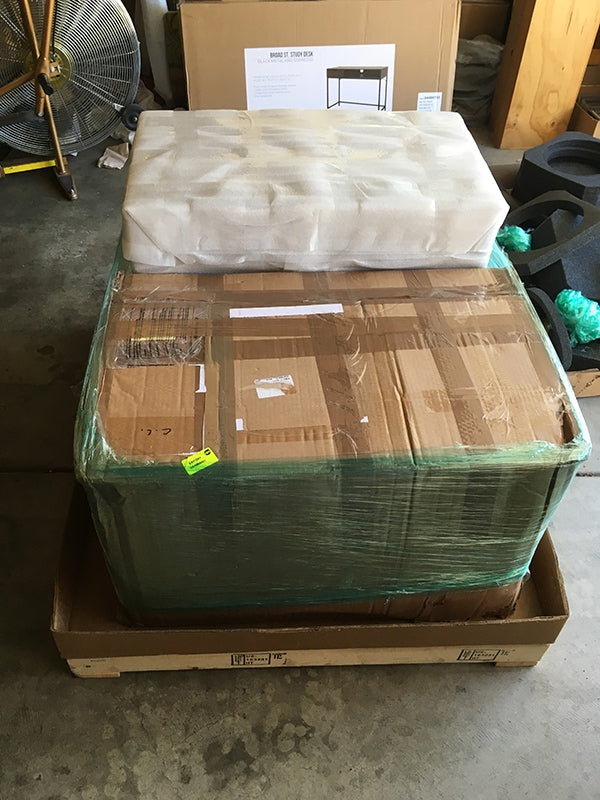
 

The system delivered, minus the outer box.

The system delivered, minus the outer box.


The LX521s are an open-baffle, dipole design that comes with a pair of five-channel amps (with analog signal processing) and dedicated SpeakON cable connections. The woofer cabinet is completely separate from the upper driver baffle, which straddles it with a “bridge.” A very clever element of the design is that all wiring is concealed, save for the last inch or two at the drivers themselves. The cable connections are at the bottom back of the two parts.
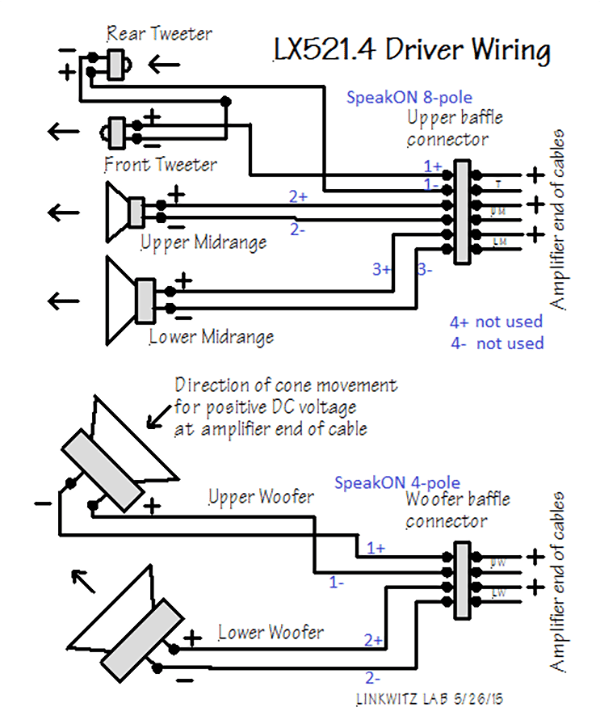
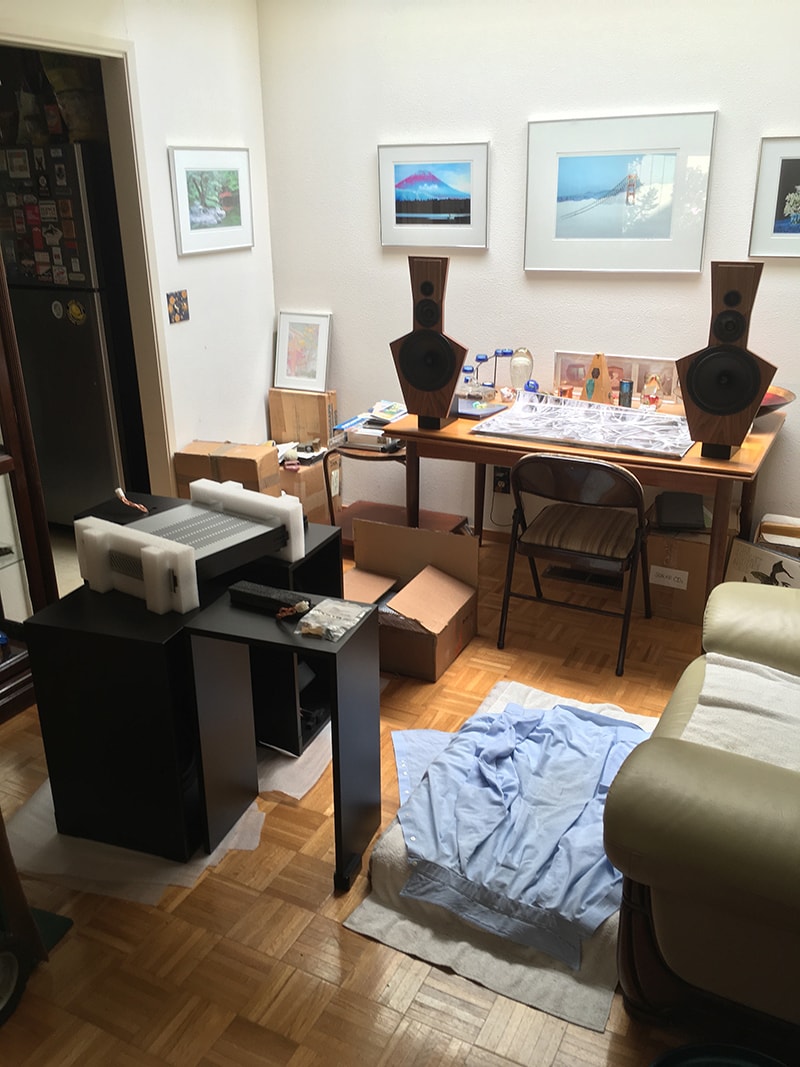


Image of speaker in parts prior to assembly.


Pardon the mess – this is a real-world living space (that’s my cat’s bed in front of the chair).

Pardon the mess – this is a real-world living space (that’s my cat’s bed in front of the chair).


I had to do some assembly, and I have a “Confessions of a Setup Man” story of my own. After I connected the driver baffle to the bridge and had gotten everything connected in place (amps, speaker cables, etc.), it was time to fire them up. I cued up an album, but nothing came out. Panic time! I looked at the amps and thought, “Aren’t there pilot lights that should be lit?” I knew I had flipped the power switches. Well, it turned out that while I was running the rather bulky speaker cables behind the equipment racks, I had somehow dislodged the AC plug for the power strip that fed the amps. Relief! I plugged it back in again and anticipated beautiful music. This time, all I heard was the bass. In checking the connections to the bridge, I eventually realized that these unfamiliar SpeakON connectors needed to be pushed in and turned to lock in place. This time I heard what I was hoping for – incredible sound.


Given the layout of my living room, I don’t have a lot of flexibility in determining speaker placement. Hardcore audiophiles may quibble with the big-screen TV and the coffee table as reflective surfaces, but the LX521s don’t seem to notice them.

Given the layout of my living room, I don’t have a lot of flexibility in determining speaker placement. Hardcore audiophiles may quibble with the big-screen TV and the coffee table as reflective surfaces, but the LX521s don’t seem to notice them.


Photo of the front of the speaker.


Note the cable connections at the bottom and the relative lack of exposed wiring.

Note the cable connections at the bottom and the relative lack of exposed wiring.


I know it’s a bit of a cliché, but these speakers truly disappear. They present a soundstage that is slightly behind the plane of the speakers, but perfectly integrated with the room. Every friend that I have played them for has had the same impression. Even my girlfriend, whose hearing is a bit compromised (and who had never really appreciated the sound I was getting before), agreed that the LX521s were a big step up. Siegfried Linkwitz felt that the speaker design parameters that contributed most to realistic sound were (in order of importance) dispersion pattern, frequency response and power handling. He held a number of views that went counter to accepted audiophile tenets – among them, that room correction was not needed if the speaker was properly designed. He was also not a believer in premium cabling or power conditioners (except in areas prone to lightning strikes).

Good recordings sound amazing on the LX521s, and lesser recordings still manage to generate a level of interest that wasn’t there with my other speakers. These speakers unravel the most densely arranged elements of a recording. The spatial presentation and delineation of instruments is on another level. My direct-to-disc LP of the LA4 (Just Friends) on the Concord Jazz label sounds incredibly live and present. Bud Shank’s saxophone is in the room.


Another area in which the LX521s excel involves the reproduction of acoustic (standup) bass. A great demo track for that is Patricia Barber’s slow and sensual cover of Bobbie Gentry’s “Ode to Billie Joe,” from the album Café Blue. The arrangement consists solely of voice, bass, and finger snaps. The bass tone and attack are startlingly realistic.


Elaborate productions, such as the recordings by Sade, showcase the speakers’ ability to separate every instrument. The complexity of the arrangement of “Smooth Operator” is in sharp contrast to the minimal nature of the Patricia Barber track. A wide array of percussion instruments shares the stage with keyboards, guitar, bass, and drums.


I’m having a ball introducing true high-end sound to my friends who had never experienced it.

There may be systems out there with greater resolution (and heftier price tags), but I am one happy camper with these speakers. I feel no need to consider any further changes to my setup unless a piece fails. I might even drop my subscriptions to Stereophile and The Absolute Sound, although I still enjoy reading about stratospherically priced audio equipment.

For more information, visit the Linkwitz website.

The Linkwitz Lab website also has a lot of information on a wide variety of topics.


Header image: Rich is now the proud owner of these puppies. Photo courtesy of Frank Brenner.

More from Issue 171

View All Articles in Issue 171

Search Copper Magazine

#229 The Earliest Stars of Country Music, Part Three by Jeff Weiner Apr 06, 2026 #229 The Healing Power of Music and Sound at the Omega Institute by Joe Caplan Apr 06, 2026 #229 CanJam NYC 2026 Show Report: Heady Sound, Part One by Frank Doris Apr 06, 2026 #229 Florida Audio Expo 2026: Warming Up to High-End Audio, Part One by Frank Doris Apr 06, 2026 #229 Quick Takes: Anne Bisson, Sam Morrison, The Velvet Underground, and the Stooges by Frank Doris Apr 06, 2026 #229 The Vinyl Beat: New Arrivals, and Old Audio Show Demo Scores to Settle by Rudy Radelic Apr 06, 2026 #229 Harvard Gets a High-End Audio Education by Frank Doris Apr 06, 2026 #229 No Country for Old Knees by B. Jan Montana Apr 06, 2026 #229 How To Play in A Rock Band, 22: Encounters With Famous Musicians, Part 1 by Frank Doris Apr 06, 2026 #229 The Soulful Grooves of Guinea-Bissau by Steve Kindig Apr 06, 2026 #229 Four-Hand Piano Performance at Its Finest by Stephan Haberthür Apr 06, 2026 #229 The People Who Make Audio Happen: Supreme Acoustics Systems’ Las Vegas Grand Opening by Harris Fogel Apr 06, 2026 #229 Blue Öyster Cult: Tyranny and Expectations by Wayne Robins Apr 06, 2026 #229 Guitarist Rick Vito’s Cinematic New Album, Slidemaster by Ray Chelstowski Apr 06, 2026 #229 Measurements and Observational Listening by Paul McGowan Apr 06, 2026 #229 PS Audio in the News by PS Audio Staff Apr 06, 2026 #229 Back to My Reel-to-Reel Roots, Part 28: The Cassette Strikes Back by Ken Kessler Apr 06, 2026 #229 Are You Receiving Me? by Frank Doris Apr 06, 2026 #229 Hospitality by Peter Xeni Apr 06, 2026 #229 Cantina Gateway by James Schrimpf Apr 06, 2026 #228 Serita’s Black Rose Duo Shakes Your Soul With a Blend of Funk, Rock, Blues and a Whole Lot More by Frank Doris Mar 02, 2026 #228 Vinyl, A Love Story by Wayne Robins Mar 02, 2026 #228 Thrill Seeker by B. Jan Montana Mar 02, 2026 #228 The Vinyl Beat: Donald Byrd, Bill Evans, Wes Montgomery, Eddie Palmieri and Frank Sinatra by Rudy Radelic Mar 02, 2026 #228 Listening to Prestige: The History of a Vitally Important Jazz Record Label by Frank Doris Mar 02, 2026 #228 How to Play in a Rock Band, 21: Touring With James Lee Stanley by Frank Doris Mar 02, 2026 #228 The NAMM 2026 Show: The Music Industry’s Premier Event by John Volanski Mar 02, 2026 #228 The Earliest Stars of Country Music, Part Two by Jeff Weiner Mar 02, 2026 #228 From The Audiophile's Guide: A Brief History of Stereophonic Sound by Paul McGowan Mar 02, 2026 #228 A Bone to Pick With Streaming Audio by Frank Doris Mar 02, 2026 #228 Blast Off With Bluesman Duke Robillard by Ray Chelstowski Mar 02, 2026 #228 A Visit to the Marten Loudspeaker Factory in Göteborg, Sweden by Ingo Schulz and Sebastian Polcyn Mar 02, 2026 #228 Pure Distortion by Peter Xeni Mar 02, 2026 #228 A Nagra Factory Tour by Markus "Marsu" Manthey Mar 02, 2026 #228 Back to My Reel-to-Reel Roots, Part 27: Noodge and Ye Shall Receive, Part Two by Ken Kessler Mar 02, 2026 #228 PS Audio in the News by PS Audio Staff Mar 02, 2026 #228 90-Degree Stereo by Frank Doris Mar 02, 2026 #228 The Keys to Art by Rich Isaacs Mar 02, 2026 #227 Seth Lewis Gets in the Groove With Take a Look Around: a Tribute to the Meters by Frank Doris Feb 02, 2026 #227 Passport to Sound: May Anwar’s Audio Learning Experience for Young People by Frank Doris Feb 02, 2026 #227 Conjectures on Cosmic Consciousness by B. Jan Montana Feb 02, 2026 #227 The Big Takeover Turns 45 by Wayne Robins Feb 02, 2026 #227 Music and Chocolate: On the Sensory Connection by Joe Caplan Feb 02, 2026 #227 Singer/Songwriter Chris Berardo: Getting Wilder All the Time by Ray Chelstowski Feb 02, 2026 #227 The Earliest Stars of Country Music, Part One by Jeff Weiner Feb 02, 2026 #227 The Vinyl Beat Goes Down to Tijuana (By Way of Los Angeles), Part Two by Rudy Radelic Feb 02, 2026 #227 How to Play in a Rock Band, 20: On the Road With Blood, Sweat & Tears’ Guitarist Gabe Cummins by Frank Doris Feb 02, 2026

Audio Nirvana (I Found It!)

Audio Nirvana (I Found It!)

A little background: the first article I wrote for Copper back in 2019 was about a speaker demonstration at the home of the late designer and engineer Siegfried Linkwitz (“A Visit to a Linkwitz Open House,” Issue 92). Years before, I had the privilege of paying a visit while Siegfried was still alive. He was a gracious and unpretentious man who gave freely of his time, although he did not know me before I requested an audition. After he passed away in 2018, Dr. Frank Brenner, under the company name of EarFood GmbH took over the manufacture and promotion of Siegfried’s speaker designs as well as presenting demos at the Linkwitz home and other locations. Prior to that, Siegfried had sold only plans for DIY builders, and the Madisound company sold the SEAS driver complement along with a flat pack of cabinet materials for the adventurous to build themselves. Siegfried never got into manufacturing. The Madisound driver kits are still available, but the flat pack is currently out of stock.

I had contributed a number of photos to the “Parting Shot” feature, but hadn’t written anything for the magazine. Former editor Bill Leebens was going to be in my neck of the woods to cover the California Audio Show. I was looking forward to meeting him, and I let him know about a demonstration of the Linkwitz LX521.4 speakers that was occurring the same weekend. I asked if he would like to attend, but he said he would be too busy covering the show. When I proposed writing a report on the event myself, he thought that would be fine.

I didn’t consider becoming a regular contributor until Frank Doris took over as editor. One of his first actions was to reach out to all who had written for the magazine, to get acquainted and find out what topics we wanted to write about. I suggested doing some articles on progressive rock and that started the ball rolling.

Some time later, I wrote about babysitting a pair of very large $90K speakers that belonged to a friend who needed to downsize temporarily (“Once in a Lifetime,” Issue 129). I ended up having them for over a year, during which time I enjoyed them immensely and became convinced that I needed to bite the bullet and buy what would be my ultimate speakers. My friend finally took the big boys back a couple of months ago, and it was back to my MartinLogan Aeon-I electrostatics (w/subwoofer). They sounded pretty good, but it just wasn’t the same…

It was time to make good on my plan to upgrade. Based on reviews that had intrigued me, I made a list of the speakers that I hoped to be able to audition at home (in addition to the Linkwitz LX521):

Eikon Audio Image 1 (includes amplification)
Gershman Acoustics Grande Avant Garde
GoldenEar Triton Reference
MBL 120 or 126
Muraudio SP 1
PS Audio Aspen FR30
Von Schweikert Audio Endeavor SE
Wilson Audio SabrinaX
YG Acoustics Carmel 2

I have no doubt that they are all worthy contenders, although some (such as the PS Audio) were probably too big for my room. I never got around to trying any of them because I ended up buying the very Linkwitz demo system that our editor had heard (and been impressed with) at the AXPONA show earlier this year!

I had to order longer speaker cables and pay for insurance and shipping from the Midwest, but they arrived well packed on a 200-pound pallet about a month ago.


The system delivered, minus the outer box.

The system delivered, minus the outer box.


The LX521s are an open-baffle, dipole design that comes with a pair of five-channel amps (with analog signal processing) and dedicated SpeakON cable connections. The woofer cabinet is completely separate from the upper driver baffle, which straddles it with a “bridge.” A very clever element of the design is that all wiring is concealed, save for the last inch or two at the drivers themselves. The cable connections are at the bottom back of the two parts.
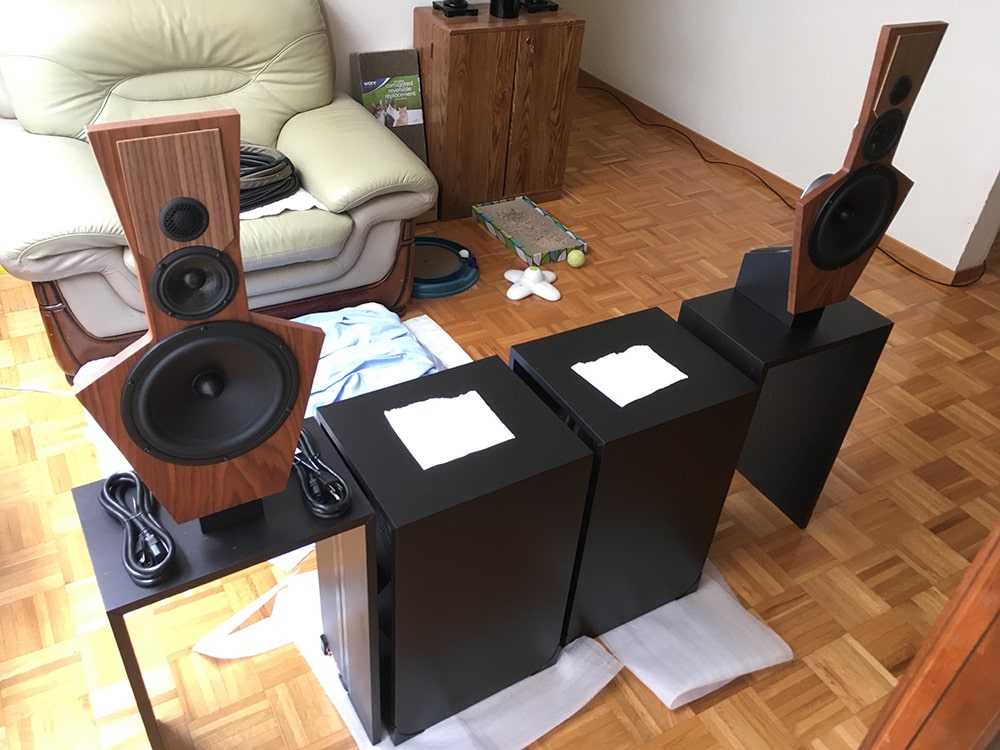


Image of speaker in parts prior to assembly.


Pardon the mess – this is a real-world living space (that’s my cat’s bed in front of the chair).

Pardon the mess – this is a real-world living space (that’s my cat’s bed in front of the chair).


I had to do some assembly, and I have a “Confessions of a Setup Man” story of my own. After I connected the driver baffle to the bridge and had gotten everything connected in place (amps, speaker cables, etc.), it was time to fire them up. I cued up an album, but nothing came out. Panic time! I looked at the amps and thought, “Aren’t there pilot lights that should be lit?” I knew I had flipped the power switches. Well, it turned out that while I was running the rather bulky speaker cables behind the equipment racks, I had somehow dislodged the AC plug for the power strip that fed the amps. Relief! I plugged it back in again and anticipated beautiful music. This time, all I heard was the bass. In checking the connections to the bridge, I eventually realized that these unfamiliar SpeakON connectors needed to be pushed in and turned to lock in place. This time I heard what I was hoping for – incredible sound.


Given the layout of my living room, I don’t have a lot of flexibility in determining speaker placement. Hardcore audiophiles may quibble with the big-screen TV and the coffee table as reflective surfaces, but the LX521s don’t seem to notice them.

Given the layout of my living room, I don’t have a lot of flexibility in determining speaker placement. Hardcore audiophiles may quibble with the big-screen TV and the coffee table as reflective surfaces, but the LX521s don’t seem to notice them.


Photo of the front of the speaker.


Note the cable connections at the bottom and the relative lack of exposed wiring.

Note the cable connections at the bottom and the relative lack of exposed wiring.


I know it’s a bit of a cliché, but these speakers truly disappear. They present a soundstage that is slightly behind the plane of the speakers, but perfectly integrated with the room. Every friend that I have played them for has had the same impression. Even my girlfriend, whose hearing is a bit compromised (and who had never really appreciated the sound I was getting before), agreed that the LX521s were a big step up. Siegfried Linkwitz felt that the speaker design parameters that contributed most to realistic sound were (in order of importance) dispersion pattern, frequency response and power handling. He held a number of views that went counter to accepted audiophile tenets – among them, that room correction was not needed if the speaker was properly designed. He was also not a believer in premium cabling or power conditioners (except in areas prone to lightning strikes).

Good recordings sound amazing on the LX521s, and lesser recordings still manage to generate a level of interest that wasn’t there with my other speakers. These speakers unravel the most densely arranged elements of a recording. The spatial presentation and delineation of instruments is on another level. My direct-to-disc LP of the LA4 (Just Friends) on the Concord Jazz label sounds incredibly live and present. Bud Shank’s saxophone is in the room.


Another area in which the LX521s excel involves the reproduction of acoustic (standup) bass. A great demo track for that is Patricia Barber’s slow and sensual cover of Bobbie Gentry’s “Ode to Billie Joe,” from the album Café Blue. The arrangement consists solely of voice, bass, and finger snaps. The bass tone and attack are startlingly realistic.


Elaborate productions, such as the recordings by Sade, showcase the speakers’ ability to separate every instrument. The complexity of the arrangement of “Smooth Operator” is in sharp contrast to the minimal nature of the Patricia Barber track. A wide array of percussion instruments shares the stage with keyboards, guitar, bass, and drums.


I’m having a ball introducing true high-end sound to my friends who had never experienced it.

There may be systems out there with greater resolution (and heftier price tags), but I am one happy camper with these speakers. I feel no need to consider any further changes to my setup unless a piece fails. I might even drop my subscriptions to Stereophile and The Absolute Sound, although I still enjoy reading about stratospherically priced audio equipment.

For more information, visit the Linkwitz website.

The Linkwitz Lab website also has a lot of information on a wide variety of topics.


Header image: Rich is now the proud owner of these puppies. Photo courtesy of Frank Brenner.

0 comments

Leave a comment

0 Comments

Your avatar

Loading comments...

🗑️ Delete Comment

Enter moderator password to delete this comment:

✏️ Edit Comment

Enter your email to verify ownership: