COPPER

A PS Audio Publication

Issue 14 • Free Online Magazine

Issue 14 VINTAGE WHINE

Are We Keeping Up? (With Inflation)

This issue we’re going to take a slight detour from our usual bios and company histories. Don’t worry: the Wayback Machine will still get a workout.

Along with being a total nerd when it comes to vintage gear, I confess to being obsessed with statistical analysis. I don’t pretend to have any particular proficiency with statistics, but I do like to parse data to the best of my ability. It’s inevitable, then, that I would spend time ruminating on the cost of vintage gear when new, and what the equivalent cost would be today, compensated for inflation. The results are often interesting— and occasionally, just plain baffling.

In 1980 I toured the Klipsch factory in Hope, Arkansas (this isn’t a complete non sequitur–I promise). Aside from meeting Paul, the most memorable aspect was watching Klipschorns being constructed. As you might expect, it doesn’t happen quickly; I’ve forgotten how many pounds of screws go into each plywood cabinet (Paul maintained that MDF sounded bad, and wouldn’t hold screws), but it’s a whole lot of screws. A power screwdriver helps, but it’s still a job that is largely manual, and takes time.

Back in 1964[1], the published prices for a single Klipschorn ranged from $514 (unfinished) to $852 (hand-rubbed finish). So: $1028-$1704, per pair. Keep in mind this was at a time when the average income was around $6,000/year, and the average new home was $13,500. Clearly, Klipschorns weren’t cheap. How would that translate to 2016 dollars? The CPI Inflation Calculator tells us that the range of $1028-$1704 would be equivalent to $7980-$13,227 in today’s money. Not cheap, but compared to today’s megabuck monolith speakers, not extortionate.

Interestingly enough, those labor-intensive K-horns are still made, and sell for $12,000/pair for a standard model, and $16,000/pair for the limited-edition 70th Anniversary model. Really, over the past 52 years, the price of Klipschorns has stayed fairly level. The fact that K-horns are still made and are still largely the same, tends to keep prices down for old ones; I’ve never seen used K-horns for more than $3000 or so.

Given that worker wages have increased 10 times or more since 1964, wouldn’t it make sense for K-horn prices to have gone way up? And yet, they haven’t. Somewhere, I bet Paul is happy.

From the massive to the minute, the other extreme of the reproduction chain is the phono cartridge. Like the K-horn, the Ortofon SPU moving-coil cartridge is still in production; also like the Klipschorn, there have been some changes and improvements through the years. There is a bewildering array of SPU variants, but Ortofon just introduced two models with integrated headshells that are very similar to the SPUs of 1964. The 1964 SPU/GT was $49.95 with spherical stylus, $75 with the newfangled elliptical stylus. Translated to 2016 dollars: $387.75 and $582.21, respectively. The new SPU models cost $599 for the spherical, $659 for the elliptical. Elliptical styli are commonplace these days, so the decrease in price differential between the two types makes sense; while the prices are a little higher than the 1964 versions, it’s not a huge increase. Given that most moving coils start at several times those prices, they might even be considered bargains.

Based upon those two examples, you might think that hi-fi prices have stayed fairly level over the decades. Maybe—maybe not. Things get weird with products that are no longer made, and which have become desirable as collectibles. As is often said of land, “they ain’t makin’ any more of that.”

Take for example, the JBL Paragon. A masterpiece of mid-century modern design by Arnold Wolf, at 9 feet in length and 850 pounds, few products can rival the Paragon for sheer presence. Producing both channels from one massive enclosure, there was and is nothing else like it. About 1000 Paragons were made between 1957 and 1983, making it JBL’s longest-running product.

Back in 1964, the price of the Paragon was $2250, considerably more than a pair of Klipschorns or any other speaker on the US market; the drivers alone retailed for around $1200, about the price of a pair of KLH 9 electrostats. In 2016 dollars, that $2250 translates into about $17,500. That’s certainly not cheap, but it’s difficult to imagine that it could be produced today for even four or five times that amount. Currently on Ebay there are two Paragons; one is Buy It Now priced at $40,000; the other, at $50,000. Replica Paragons made in Japan routinely sell for six figures.

The relative scarcity of the Paragon has driven prices up drastically in recent years (I bought one in the early ‘80’s for $600…it is to weep). Given the complexity of the design and its components, it’s hard to imagine that JBL ever made money on the Paragon. It was likely a halo product, and for many years was seen as the absolute ultimate loudspeaker system.

It took another California company, Infinity, to create speaker systems that rivaled the audacity and sheer physical presence of the Paragon. Starting with the Servo-Statik in 1968 and through the IRS (Infinity Reference Standard) series, Infinity created products of unrivaled performance, clean California modern styling, and unheard of prices (the Servo-Statik was $2000 in 1968, and needed two additional amps besides the provided bass servo amp).
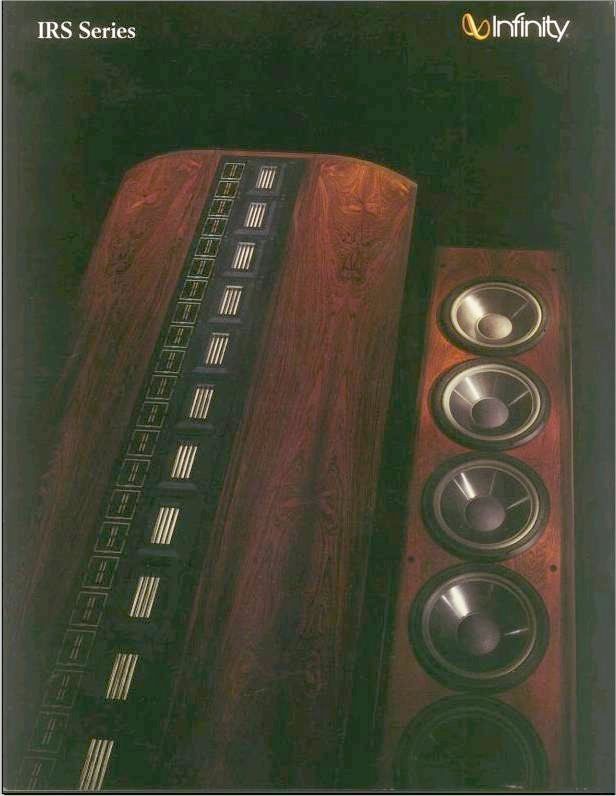
 IRS

$2000 in 1968 translates to just under $14,000 today, and it’s hard to imagine being able to build a system as complex as the Servo-Statik for that little, today. 1980’s IRS appeared at $20,000; in 2016 bucks, that’s $58,409. While clearly a lot of money, similar systems today sell for three to four times that.

My conclusion from all this? I’d say that audio has a number of high-value products that have held up over time…but it also has its own version of the 1%. Just as it’s hard to imagine that a $300,000 Maybach costs three times as much as an S-class Mercedes to build, it’s hard to imagine that the quarter-million dollar speakers seen today cost that much more to build than lesser models.

The late Brian Cheney coined the phrase, “The Price is the Product”, and I tend to think that beyond a certain level, prices are determined more by their potential status than by build cost.

That may be the cynic in me talking. I promise that next time I’ll return to a vintage view untainted by 2016.

[1] 1964 is used as a basis of comparison simply because I happen to have a Stereo/Hi-Fi Directory from that year.

Hey, you use whatcha got, right?

More from Issue 14

View All Articles in Issue 14

Search Copper Magazine

#226 JJ Murphy’s Sleep Paralysis is a Genre-Bending Musical Journey Through Jazz, Fusion and More by Frank Doris Jan 05, 2026 #226 Stewardship by Consent by B. Jan Montana Jan 05, 2026 #226 Food, Music, and Sensory Experience: An Interview With Professor Jonathan Zearfoss of the Culinary Institute of America by Joe Caplan Jan 05, 2026 #226 Studio Confidential: A Who’s Who of Recording Engineers Tell Their Stories by Frank Doris Jan 05, 2026 #226 Pilot Radio is Reborn, 50 Years Later: Talking With CEO Barak Epstein by Frank Doris Jan 05, 2026 #226 The Vinyl Beat Goes Down to Tijuana (By Way of Los Angeles), Part One by Rudy Radelic Jan 05, 2026 #226 Capital Audiofest 2025: Must-See Stereo, Part Two by Frank Doris Jan 05, 2026 #226 My Morning Jacket’s Carl Broemel and Tyler Ramsey Collaborate on Their Acoustic Guitar Album, Celestun by Ray Chelstowski Jan 05, 2026 #226 The People Who Make Audio Happen: CanJam SoCal 2025, Part Two by Harris Fogel Jan 05, 2026 #226 How to Play in a Rock Band, 19: Touring Can Make You Crazy, Part One by Frank Doris Jan 05, 2026 #226 Linda Ronstadt Goes Bigger by Wayne Robins Jan 05, 2026 #226 From The Audiophile’s Guide: Active Room Correction and Digital Signal Processing by Paul McGowan Jan 05, 2026 #226 PS Audio in the News by Frank Doris Jan 05, 2026 #226 Back to My Reel-to-Reel Roots, Part 25: Half-Full, Not Empty by Ken Kessler Jan 05, 2026 #226 Happy New Year! by Frank Doris Jan 05, 2026 #226 Turn It Down! by Peter Xeni Jan 05, 2026 #226 Ghost Riders by James Schrimpf Jan 05, 2026 #226 A Factory Tour of Audio Manufacturer German Physiks by Markus "Marsu" Manthey Jan 04, 2026 #225 Capital Audiofest 2025: Must-See Stereo, Part One by Frank Doris Dec 01, 2025 #225 Otis Taylor and the Electrics Delivers a Powerful Set of Hypnotic Modern Blues by Frank Doris Dec 01, 2025 #225 A Christmas Miracle by B. Jan Montana Dec 01, 2025 #225 T.H.E. Show New York 2025, Part Two: Plenty to See, Hear, and Enjoy by Frank Doris Dec 01, 2025 #225 Underappreciated Artists, Part One: Martin Briley by Rich Isaacs Dec 01, 2025 #225 Rock and Roll is Here to Stay by Wayne Robins Dec 01, 2025 #225 A Lifetime of Holiday Record (and CD) Listening by Rudy Radelic Dec 01, 2025 #225 Little Feat: Not Saying Goodbye, Not Yet by Ray Chelstowski Dec 01, 2025 #225 How to Play in a Rock Band, Part 18: Dealing With Burnout by Frank Doris Dec 01, 2025 #225 The People Who Make Audio Happen: CanJam SoCal 2025 by Harris Fogel Dec 01, 2025 #225 Chicago’s Sonic Sanctuaries: Four Hi‑Fi Listening Bars Channeling the Jazz‑Kissa Spirit by Olivier Meunier-Plante Dec 01, 2025 #225 From The Audiophile’s Guide: Controlling Bass Frequencies Through Membrane Absorbers (and How to Build Your Own) by Paul McGowan Dec 01, 2025 #225 Your Editor’s Tips for Attending Audio Shows by Frank Doris Dec 01, 2025 #225 PS Audio in the News by Frank Doris Dec 01, 2025 #225 Back to My Reel-to-Reel Roots, Part 24 by Ken Kessler Dec 01, 2025 #225 Holiday Music by Frank Doris Dec 01, 2025 #225 Puppy Prognostication by Peter Xeni Dec 01, 2025 #225 How to Post Comments on Copper by Frank Doris Dec 01, 2025 #225 Living Color by Rudy Radelic Dec 01, 2025 #224 T.H.E. Show New York 2025, Part One: A New Beginning by Frank Doris Nov 03, 2025 #224 Fool’s Leap of Faith is the Extraordinary Octave Records Debut from Singer/Songwriter Tyler Burba and Visit by Frank Doris Nov 03, 2025 #224 The Beatles’ “Aeolian Cadences.” What? by Wayne Robins Nov 03, 2025 #224 Persona Non Grata by B. Jan Montana Nov 03, 2025 #224 Talking With Recording Engineer Barry Diament of Soundkeeper Recordings, Part Two by Frank Doris Nov 03, 2025 #224 B Sides, B Movies, and Beware of Zombies by Rudy Radelic Nov 03, 2025 #224 The Burn-In Chronicles: 1,000 Hours to Sonic Salvation by Olivier Meunier-Plante Nov 03, 2025 #224 A Conversation With Mat Weisfeld of VPI Industries by Joe Caplan Nov 03, 2025 #224 Blues-Rocker Kenny Wayne Shepherd Celebrates 30 Years of Ledbetter Heights by Ray Chelstowski Nov 03, 2025 #224 Playing in a Rock Band, 17: When Good Gigs Go Bad, Part Two by Frank Doris Nov 03, 2025

Are We Keeping Up? (With Inflation)

This issue we’re going to take a slight detour from our usual bios and company histories. Don’t worry: the Wayback Machine will still get a workout.

Along with being a total nerd when it comes to vintage gear, I confess to being obsessed with statistical analysis. I don’t pretend to have any particular proficiency with statistics, but I do like to parse data to the best of my ability. It’s inevitable, then, that I would spend time ruminating on the cost of vintage gear when new, and what the equivalent cost would be today, compensated for inflation. The results are often interesting— and occasionally, just plain baffling.

In 1980 I toured the Klipsch factory in Hope, Arkansas (this isn’t a complete non sequitur–I promise). Aside from meeting Paul, the most memorable aspect was watching Klipschorns being constructed. As you might expect, it doesn’t happen quickly; I’ve forgotten how many pounds of screws go into each plywood cabinet (Paul maintained that MDF sounded bad, and wouldn’t hold screws), but it’s a whole lot of screws. A power screwdriver helps, but it’s still a job that is largely manual, and takes time.

Back in 1964[1], the published prices for a single Klipschorn ranged from $514 (unfinished) to $852 (hand-rubbed finish). So: $1028-$1704, per pair. Keep in mind this was at a time when the average income was around $6,000/year, and the average new home was $13,500. Clearly, Klipschorns weren’t cheap. How would that translate to 2016 dollars? The CPI Inflation Calculator tells us that the range of $1028-$1704 would be equivalent to $7980-$13,227 in today’s money. Not cheap, but compared to today’s megabuck monolith speakers, not extortionate.

Interestingly enough, those labor-intensive K-horns are still made, and sell for $12,000/pair for a standard model, and $16,000/pair for the limited-edition 70th Anniversary model. Really, over the past 52 years, the price of Klipschorns has stayed fairly level. The fact that K-horns are still made and are still largely the same, tends to keep prices down for old ones; I’ve never seen used K-horns for more than $3000 or so.

Given that worker wages have increased 10 times or more since 1964, wouldn’t it make sense for K-horn prices to have gone way up? And yet, they haven’t. Somewhere, I bet Paul is happy.

From the massive to the minute, the other extreme of the reproduction chain is the phono cartridge. Like the K-horn, the Ortofon SPU moving-coil cartridge is still in production; also like the Klipschorn, there have been some changes and improvements through the years. There is a bewildering array of SPU variants, but Ortofon just introduced two models with integrated headshells that are very similar to the SPUs of 1964. The 1964 SPU/GT was $49.95 with spherical stylus, $75 with the newfangled elliptical stylus. Translated to 2016 dollars: $387.75 and $582.21, respectively. The new SPU models cost $599 for the spherical, $659 for the elliptical. Elliptical styli are commonplace these days, so the decrease in price differential between the two types makes sense; while the prices are a little higher than the 1964 versions, it’s not a huge increase. Given that most moving coils start at several times those prices, they might even be considered bargains.

Based upon those two examples, you might think that hi-fi prices have stayed fairly level over the decades. Maybe—maybe not. Things get weird with products that are no longer made, and which have become desirable as collectibles. As is often said of land, “they ain’t makin’ any more of that.”

Take for example, the JBL Paragon. A masterpiece of mid-century modern design by Arnold Wolf, at 9 feet in length and 850 pounds, few products can rival the Paragon for sheer presence. Producing both channels from one massive enclosure, there was and is nothing else like it. About 1000 Paragons were made between 1957 and 1983, making it JBL’s longest-running product.

Back in 1964, the price of the Paragon was $2250, considerably more than a pair of Klipschorns or any other speaker on the US market; the drivers alone retailed for around $1200, about the price of a pair of KLH 9 electrostats. In 2016 dollars, that $2250 translates into about $17,500. That’s certainly not cheap, but it’s difficult to imagine that it could be produced today for even four or five times that amount. Currently on Ebay there are two Paragons; one is Buy It Now priced at $40,000; the other, at $50,000. Replica Paragons made in Japan routinely sell for six figures.

The relative scarcity of the Paragon has driven prices up drastically in recent years (I bought one in the early ‘80’s for $600…it is to weep). Given the complexity of the design and its components, it’s hard to imagine that JBL ever made money on the Paragon. It was likely a halo product, and for many years was seen as the absolute ultimate loudspeaker system.

It took another California company, Infinity, to create speaker systems that rivaled the audacity and sheer physical presence of the Paragon. Starting with the Servo-Statik in 1968 and through the IRS (Infinity Reference Standard) series, Infinity created products of unrivaled performance, clean California modern styling, and unheard of prices (the Servo-Statik was $2000 in 1968, and needed two additional amps besides the provided bass servo amp).

 IRS

$2000 in 1968 translates to just under $14,000 today, and it’s hard to imagine being able to build a system as complex as the Servo-Statik for that little, today. 1980’s IRS appeared at $20,000; in 2016 bucks, that’s $58,409. While clearly a lot of money, similar systems today sell for three to four times that.

My conclusion from all this? I’d say that audio has a number of high-value products that have held up over time…but it also has its own version of the 1%. Just as it’s hard to imagine that a $300,000 Maybach costs three times as much as an S-class Mercedes to build, it’s hard to imagine that the quarter-million dollar speakers seen today cost that much more to build than lesser models.

The late Brian Cheney coined the phrase, “The Price is the Product”, and I tend to think that beyond a certain level, prices are determined more by their potential status than by build cost.

That may be the cynic in me talking. I promise that next time I’ll return to a vintage view untainted by 2016.

[1] 1964 is used as a basis of comparison simply because I happen to have a Stereo/Hi-Fi Directory from that year.

Hey, you use whatcha got, right?

0 comments

Leave a comment

0 Comments

Your avatar

Loading comments...

🗑️ Delete Comment

Enter moderator password to delete this comment: