COPPER

A PS Audio Publication

Issue 101 • Free Online Magazine

Issue 101 REVOLUTIONS PER MINUTE

An Ode to Cassette Tape - Part One

An Ode to Cassette Tape - Part One

I still remember how, as a very young boy, I had to handle a 7-inch record with both hands and I still could barely manage to put it on the turntable, having to climb up on a chair to reach it. This is how big the 7-inch format was, or how small I was at the time (a question of perspective)! The 12-inch records were far too big for me; I couldn’t even remove them from their sleeve!

I observed in astonishment as my father was holding a 12-inch LP with one hand, four fingers on the label, thumb on the edge, and wondered if I would ever become big enough to do that. Back then, I couldn’t even do that on a 7-inch single!


That sure wasn’t me! I preferred loudspeakers, and I still prefer them to be bigger than me, even nowadays.

Having been taught that records could be easily damaged and were of immense value, I found the experience of handling records rather stressful, because of my small size and clumsy motor skills as a toddler. However, the ensuing auditory experience was so deeply fulfilling that I had decided it was worth the stress and effort of placing the record on the turntable and putting it back in its correct place on the shelf again when I was done. But I still had to wait for dad to come home from work to ask him to put on a 12-inch record.

Luckily, there was another format, which I found much easier to deal with! The CD had not yet arrived and we did not have a reel-to-reel tape machine at home, which is probably for the better, as I would have most likely tangled myself up in knots trying to thread the tape, which would have felt like the equivalent of 8-inch wide tape in my tiny paws back then.
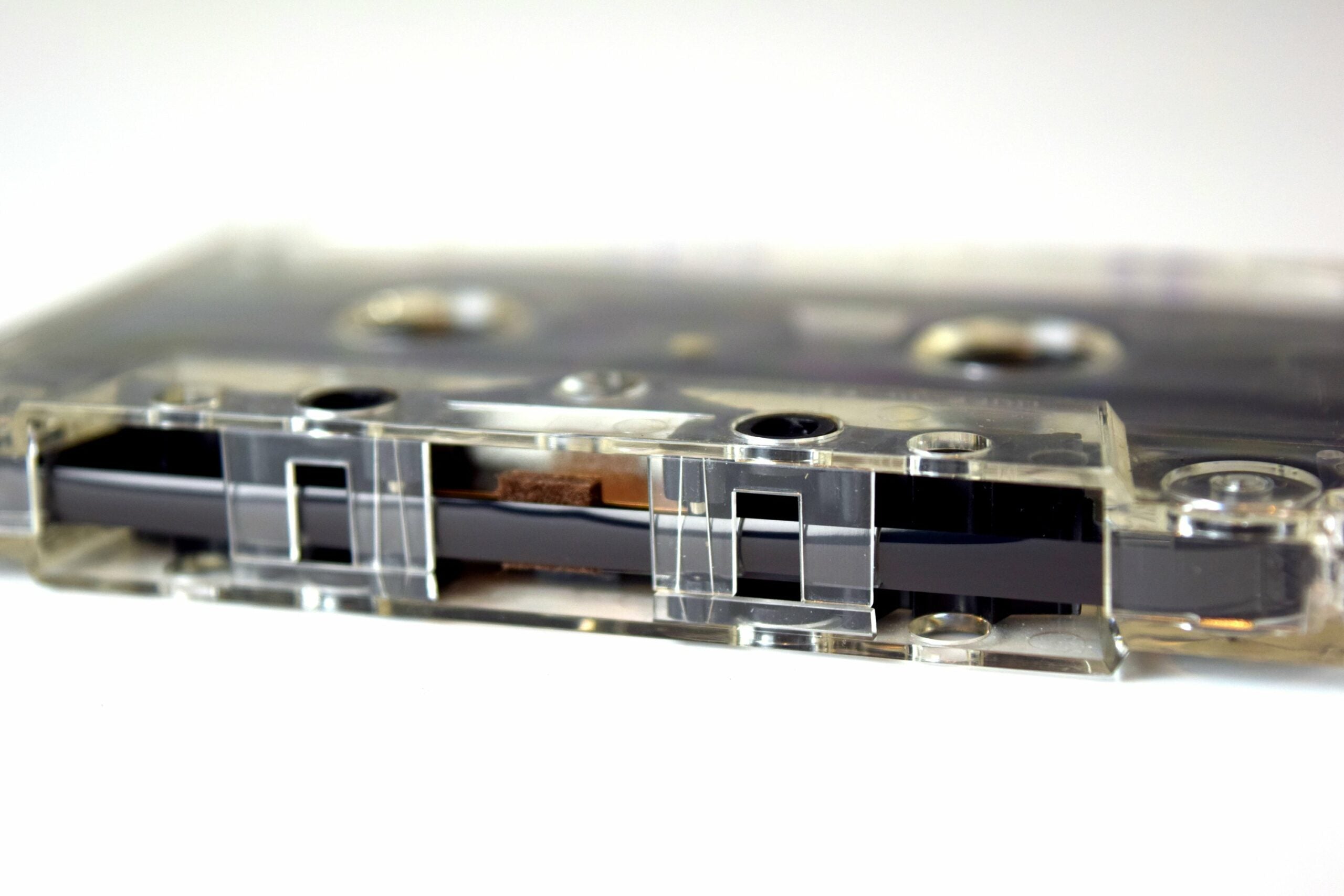
The toddler-friendly format consisted of 1/8-inch wide tape, wound on small reels, packed safely inside a plastic shell! There was no need to touch the actual tape containing the recorded information. Of course, I’m talking about cassette tape, which could be handled entirely by the shell and was small enough for me to confidently hold! As an additional bonus, the cassette deck, a vintage JVC unit, was situated on a low shelf near the floor within easy reach.
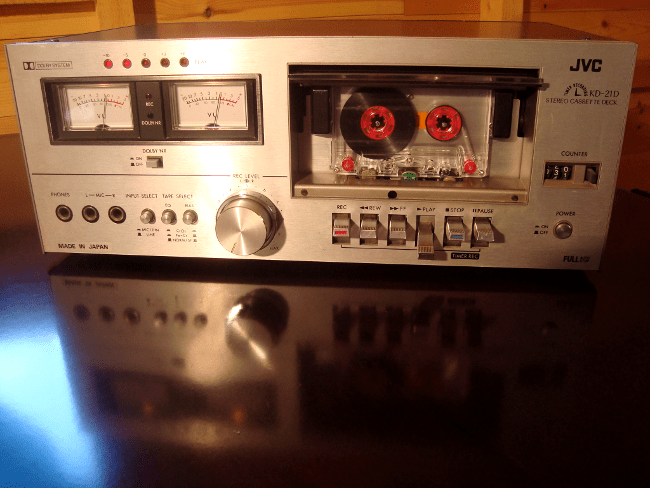
JVC cassette deck. Photo courtesy of Magnetic Fidelity.

The fact that cassette tape existed when I was a baby will perhaps give away some hints regarding my age, contrary to what some of my earlier accounts of my experience with antique audio technology may have led readers to believe. The format was introduced by Philips in 1963, but gained popularity in the 1970’s.

Not only was I able to play any of the prerecorded tapes in our collection, but, unlike our Thorens turntable, that same cassette deck could also record on blank cassettes! Both of these activities were deemed safe enough for me to pursue at will, without requiring direct supervision or assistance!

My experiences with cassette tape started when my dad decided to try to record my first words when I was about nine months old. I found the VU meters fascinating and was able to learn how to initiate the recording by simultaneously pressing the Rec and Play keys. Soon after that I learned how to adjust the recording level correctly and things rapidly escalated from there. I was building shoebox guitars with my mom (cutting a hole in a shoebox, putting rubber bands over it and sticking a piece of cardboard under them as a bridge), banging on whatever produced an interesting sound, talking, singing, and recording music from 12-inch records, to be able to enjoy the music on the records when my dad was at work.

As I grew and became able to easily handle any size records, I discovered the concept of the mixtape. Throughout my childhood, cassette tape remained the only viable means of recording sound for me. But even after graduating to reel-to-reel tape machines, disk recording lathes and all kinds of digital recording systems, cassette tape never lost its magic for me.
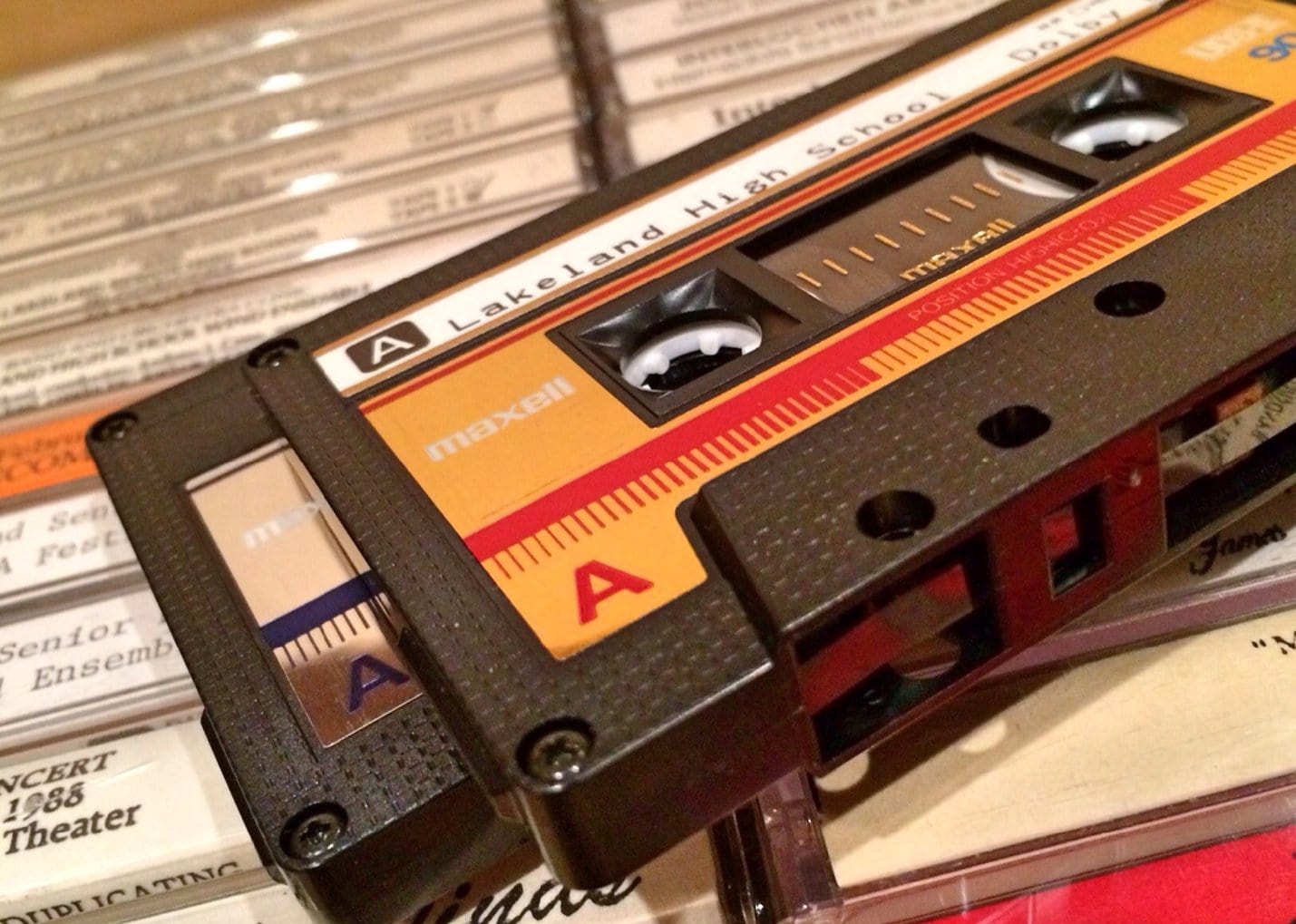
As a teenager playing guitar and keyboards, I started experimenting with more complex recording ideas, using several cassette decks and a mixer. At first it was a crude homemade mixer, then I got a cheap DJ mixer and as a young adult, after a lot of saving up and experience in professional recording and broadcasting facilities, I eventually managed to buy my first mixing console second-hand. I was still using this with my multiple cassette decks.

Shortly thereafter, I found a Tascam 414 Portastudio, which is a 4-track cassette deck that records using all four tracks in the same direction. No side A or side B. Flipping the tape over would play things backwards, which was great for special effects! The Tascam 414 ran at 3-3/4 ips (inches per second), twice the normal cassette speed of 1 7/8 ips. It offered dbx noise reduction and had a very simple built in mixer. I did hundreds of recordings on this setup and some of them came out surprisingly well.

Heavily modified Tascam 414 with the mixer section removed for use with higher quality mixing console. Photo from the author’s personal archive of audio adventures.

Not only were cassette decks generally much more affordable than professional recording equipment (especially in the second-hand market, as broken units in need of repair work which I was happy to do on my own), the blank cassette tapes were also very attractively priced for a schoolboy with limited resources. There was a dedicated blank cassette tape store in my area, whose owner would excitedly explain to me the differences between the multiple different types he was stocking.

I learned that Type I/Normal/Fe was very similar to the ferric oxide formulations used in reel-to-reel tape. Type II/High/CrO2 was coated with chromium dioxide particles and was used with a higher bias setting. Type III/FeCr was a combination of ferric oxide and chromium dioxide, while Type IV/Metal had a non-oxide metal particle coating and could take higher peak levels prior to saturation.

It was the affordability, ease of use and very decent level of performance that made cassette tape popular. By the early 1980s, the cassette tape had become the best-selling consumer format, surpassing vinyl record sales. The average cassette deck at the time could offer a reasonably flat frequency response from 30 Hz to 16 kHz while the more sophisticated units did much better, while also having good speed stability and being quite reliable. The Annual Equipment Directory in the October 1983 issue of Audio listed no less than 203 different models of cassette decks in the US market alone and those listings were far from complete!
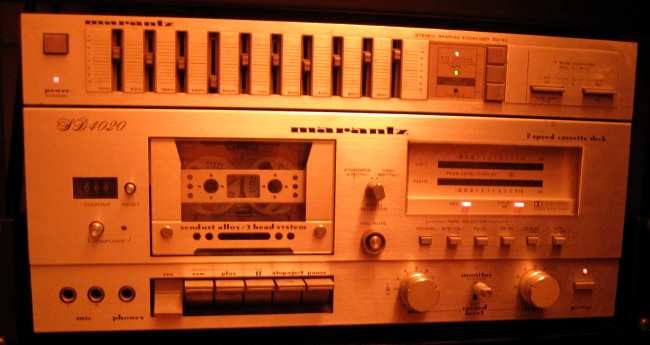
Marantz cassette deck. Photo courtesy of Magnetic Fidelity.

Being immune to vibration and shock, cassette players were widely used in cars and other mobile applications. The Sony Walkman was introduced in 1979 and paved the way for a range of products aimed at those who wanted to listen to music on the go. The iPod and iTunes owe their existence to cassette tape and the Walkman.

A Sony WM-FX421 Walkman.

Cassette tapes still form a big part of my personal music collection. I used them extensively during long road trips and made countless mixtapes on them, offering hours of entertainment to many a high school sweetheart, to whom they were frequently presented as gifts.
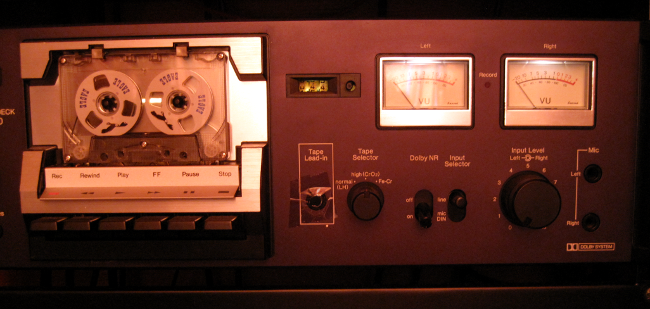
Sansui cassette deck. Photo courtesy of Magnetic Fidelity.

Throughout my professional career in audio, despite having access to much more highly regarded equipment, there were several occasions where cassette tape proved itself, even with commercial success, as we are bound to discover in Part Two…

More from Issue 101

View All Articles in Issue 101

Search Copper Magazine

#233 A Report From The Total Hi-Fi Experience Show SoCal 2026 by B. Jan Montana Aug 03, 2026 #233 Bluegrass Meets Country, Folk, Jazz and More in All That We Carried by The Squid City Slingers by Frank Doris Aug 03, 2026 #233 Corey Glover and One Tribe Nation: A Variegated Musical Collective by Ray Chelstowski Aug 03, 2026 #233 Excursions with Clive: The Late Clive Davis, A Personal History by Wayne Robins Aug 03, 2026 #233 AI, Art, and Music: A Conversation With Synthography Art by Joe Caplan Aug 03, 2026 #233 New American Symphonies: A Rediscovered Gem and a Vital Contemporary Work by Frank Doris Aug 03, 2026 #233 The Vinyl Beat: Genesis, the Dave Clark Five, Antonio Carlos Jobim and More by Rudy Radelic Aug 03, 2026 #233 How to Play in a Rock Band, 26: When It's Time to Record Your Music by Frank Doris Aug 03, 2026 #233 More From T.H.E. Show 2026, and the People Who Made it Happen by Harris Fogel Aug 03, 2026 #233 Underappreciated Artists, Part Three: Icehouse by Rich Isaacs Aug 03, 2026 #233 The Surprisingly Rich and Varied Music of Somalia by Steve Kindig Aug 03, 2026 #233 A Remarkable Discographic Legacy: The LP Recordings of the Basel Symphony Orchestra by Stephan Haberthür Aug 03, 2026 #233 From The Audiophile’s Guide: The Importance of Loudspeakers by Paul McGowan Aug 03, 2026 #233 From Swimming Pool to New Listening Room: A Conversation with Norman Varney of AV RoomService by Gilles Laferrière Aug 03, 2026 #233 PS Audio in the News by PS Audio Staff Aug 03, 2026 #233 Audio Jewelry by Peter Xeni Aug 03, 2026 #233 Enrich Your Life by Frank Doris Aug 03, 2026 #233 The Searcher by James Schrimpf Aug 03, 2026 #232 What came first: Art or Music? A Conversation With Artist Jose Acosta by Joe Caplan Jul 06, 2026 #232 Blow By Blow: The Jeff Beck Story: An Insightful Book About a Guitar Icon by Ray Chelstowski Jul 06, 2026 #232 Creed Over Camaraderie? by B. Jan Montana Jul 06, 2026 #232 Chronicles of a Sound Pilgrim at the 2026 Montreal Audiofest by Hugues Morin Jul 06, 2026 #232 The Vinyl Beat: Summer Grooves by Rudy Radelic Jul 06, 2026 #232 Hibbing Hillbilly Dylan's Acoustic Rock by Wayne Robins Jul 06, 2026 #232 Quad Quads and Plasmatronics Tweeters: An Extraordinary System Comes to Life by Frank Doris Jul 06, 2026 #232 In Praise of Live Music, Once Again by Ted Shafran Jul 06, 2026 #232 Allnic Audio’s L-9000 Preamplifier: Design and Engineering Innovation by Howard Kneller Jul 06, 2026 #232 “Best Of” Lists and Rage Bait: Enough Already by Frank Doris Jul 06, 2026 #232 Quick Takes: Bud Shank, Paulo Almeida, Jakob Dreyer, Tim Eriksen and Peter Irvine by Frank Doris Jul 06, 2026 #232 My Impressions of AXPONA 2026, Part 2 by Frank Doris Jul 06, 2026 #232 How to Play in a Rock Band, 25: Encounters With Famous Musicians, Part Three by Frank Doris Jul 06, 2026 #232 Budgets, and Systems From Small to Outrageous by Paul McGowan Jul 06, 2026 #232 PS Audio in the News by PS Audio Staff Jul 06, 2026 #232 Hand It Over by Frank Doris Jul 06, 2026 #232 Difference of Opinion by Peter Xeni Jul 06, 2026 #232 Wabi-sabi Tree by James Schrimpf Jul 06, 2026 #231 Piano Prodigy Jude Kofie Releases His Debut Album On Octave Records by Frank Doris Jun 01, 2026 #231 Underappreciated Artists, Part Two: City Boy by Rich Isaacs Jun 01, 2026 #231 Music and the Art of Creation: Talking With Saxophonist Rob Scheps by Joe Caplan Jun 01, 2026 #231 How to Play in a Rock Band, 24: Further Adventures at the 2026 Montauk Music Festival by Frank Doris Jun 01, 2026 #231 Courtney Barnett: Creature of Habit by Wayne Robins Jun 01, 2026 #231 Angine de Poitrine: Interstellar Guitar Rock Saviors Headed for Late-Night TV Pop Stardom? by Mark Lepage Jun 01, 2026 #231 My Impressions of AXPONA 2026, Part One by Frank Doris Jun 01, 2026 #231 2026 La Jolla Concours d'Elegance: Another Aesthetic Feast by B. Jan Montana Jun 01, 2026 #231 Country Music Icon Jo Dee Messina’s Bridges: A New Beginning by Ray Chelstowski Jun 01, 2026 #231 The Luxury Dispatch Hosts a Video Podcast With Ken Kessler by Ken Kessler Jun 01, 2026 #231 The Vinyl Beat: Tracking in the Motor City by Rudy Radelic Jun 01, 2026

An Ode to Cassette Tape - Part One

An Ode to Cassette Tape - Part One

I still remember how, as a very young boy, I had to handle a 7-inch record with both hands and I still could barely manage to put it on the turntable, having to climb up on a chair to reach it. This is how big the 7-inch format was, or how small I was at the time (a question of perspective)! The 12-inch records were far too big for me; I couldn’t even remove them from their sleeve!

I observed in astonishment as my father was holding a 12-inch LP with one hand, four fingers on the label, thumb on the edge, and wondered if I would ever become big enough to do that. Back then, I couldn’t even do that on a 7-inch single!


That sure wasn’t me! I preferred loudspeakers, and I still prefer them to be bigger than me, even nowadays.

Having been taught that records could be easily damaged and were of immense value, I found the experience of handling records rather stressful, because of my small size and clumsy motor skills as a toddler. However, the ensuing auditory experience was so deeply fulfilling that I had decided it was worth the stress and effort of placing the record on the turntable and putting it back in its correct place on the shelf again when I was done. But I still had to wait for dad to come home from work to ask him to put on a 12-inch record.

Luckily, there was another format, which I found much easier to deal with! The CD had not yet arrived and we did not have a reel-to-reel tape machine at home, which is probably for the better, as I would have most likely tangled myself up in knots trying to thread the tape, which would have felt like the equivalent of 8-inch wide tape in my tiny paws back then.

The toddler-friendly format consisted of 1/8-inch wide tape, wound on small reels, packed safely inside a plastic shell! There was no need to touch the actual tape containing the recorded information. Of course, I’m talking about cassette tape, which could be handled entirely by the shell and was small enough for me to confidently hold! As an additional bonus, the cassette deck, a vintage JVC unit, was situated on a low shelf near the floor within easy reach.

JVC cassette deck. Photo courtesy of Magnetic Fidelity.

The fact that cassette tape existed when I was a baby will perhaps give away some hints regarding my age, contrary to what some of my earlier accounts of my experience with antique audio technology may have led readers to believe. The format was introduced by Philips in 1963, but gained popularity in the 1970’s.

Not only was I able to play any of the prerecorded tapes in our collection, but, unlike our Thorens turntable, that same cassette deck could also record on blank cassettes! Both of these activities were deemed safe enough for me to pursue at will, without requiring direct supervision or assistance!

My experiences with cassette tape started when my dad decided to try to record my first words when I was about nine months old. I found the VU meters fascinating and was able to learn how to initiate the recording by simultaneously pressing the Rec and Play keys. Soon after that I learned how to adjust the recording level correctly and things rapidly escalated from there. I was building shoebox guitars with my mom (cutting a hole in a shoebox, putting rubber bands over it and sticking a piece of cardboard under them as a bridge), banging on whatever produced an interesting sound, talking, singing, and recording music from 12-inch records, to be able to enjoy the music on the records when my dad was at work.

As I grew and became able to easily handle any size records, I discovered the concept of the mixtape. Throughout my childhood, cassette tape remained the only viable means of recording sound for me. But even after graduating to reel-to-reel tape machines, disk recording lathes and all kinds of digital recording systems, cassette tape never lost its magic for me.

As a teenager playing guitar and keyboards, I started experimenting with more complex recording ideas, using several cassette decks and a mixer. At first it was a crude homemade mixer, then I got a cheap DJ mixer and as a young adult, after a lot of saving up and experience in professional recording and broadcasting facilities, I eventually managed to buy my first mixing console second-hand. I was still using this with my multiple cassette decks.

Shortly thereafter, I found a Tascam 414 Portastudio, which is a 4-track cassette deck that records using all four tracks in the same direction. No side A or side B. Flipping the tape over would play things backwards, which was great for special effects! The Tascam 414 ran at 3-3/4 ips (inches per second), twice the normal cassette speed of 1 7/8 ips. It offered dbx noise reduction and had a very simple built in mixer. I did hundreds of recordings on this setup and some of them came out surprisingly well.

Heavily modified Tascam 414 with the mixer section removed for use with higher quality mixing console. Photo from the author’s personal archive of audio adventures.

Not only were cassette decks generally much more affordable than professional recording equipment (especially in the second-hand market, as broken units in need of repair work which I was happy to do on my own), the blank cassette tapes were also very attractively priced for a schoolboy with limited resources. There was a dedicated blank cassette tape store in my area, whose owner would excitedly explain to me the differences between the multiple different types he was stocking.

I learned that Type I/Normal/Fe was very similar to the ferric oxide formulations used in reel-to-reel tape. Type II/High/CrO2 was coated with chromium dioxide particles and was used with a higher bias setting. Type III/FeCr was a combination of ferric oxide and chromium dioxide, while Type IV/Metal had a non-oxide metal particle coating and could take higher peak levels prior to saturation.

It was the affordability, ease of use and very decent level of performance that made cassette tape popular. By the early 1980s, the cassette tape had become the best-selling consumer format, surpassing vinyl record sales. The average cassette deck at the time could offer a reasonably flat frequency response from 30 Hz to 16 kHz while the more sophisticated units did much better, while also having good speed stability and being quite reliable. The Annual Equipment Directory in the October 1983 issue of Audio listed no less than 203 different models of cassette decks in the US market alone and those listings were far from complete!

Marantz cassette deck. Photo courtesy of Magnetic Fidelity.

Being immune to vibration and shock, cassette players were widely used in cars and other mobile applications. The Sony Walkman was introduced in 1979 and paved the way for a range of products aimed at those who wanted to listen to music on the go. The iPod and iTunes owe their existence to cassette tape and the Walkman.

A Sony WM-FX421 Walkman.

Cassette tapes still form a big part of my personal music collection. I used them extensively during long road trips and made countless mixtapes on them, offering hours of entertainment to many a high school sweetheart, to whom they were frequently presented as gifts.

Sansui cassette deck. Photo courtesy of Magnetic Fidelity.

Throughout my professional career in audio, despite having access to much more highly regarded equipment, there were several occasions where cassette tape proved itself, even with commercial success, as we are bound to discover in Part Two…

0 comments

Leave a comment

0 Comments

Your avatar

Loading comments...

🗑️ Delete Comment

Enter moderator password to delete this comment:

✏️ Edit Comment

Enter your email to verify ownership: